

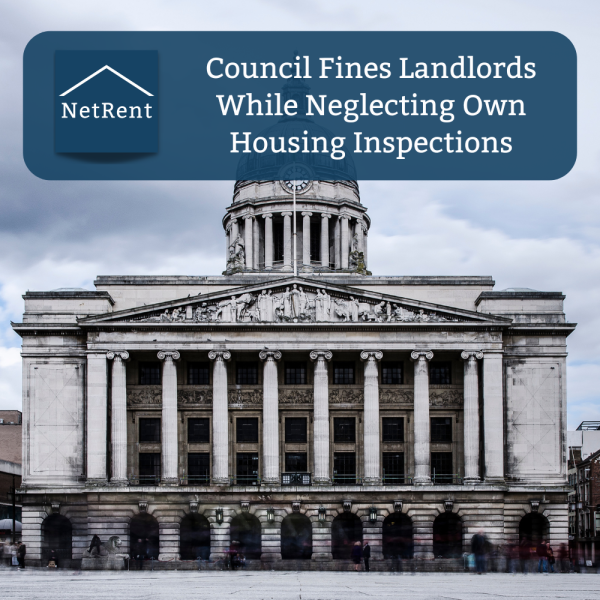
In a startling revelation, Nottingham City Council has confessed that it hasn’t conducted inspections on its own housing stock for a staggering eight years. This admission comes despite the council’s stringent enforcement of selective licensing rules, which levy punitive fines on private landlords for even minor violations.
Under the city’s selective licensing rules, implemented in 2018, private landlords are mandated to adhere to rigorous standards and inspect their properties every four months. However, while enforcing these rules on private landlords, the council itself has neglected its own responsibilities regarding housing inspections.
According to a report by the Nottingham Post, councillors were informed this week about the council’s plan to initiate a comprehensive inspection of all its council homes over the next few months. This move comes as a response to the necessity of complying with new mandatory social housing standards, highlighting the considerable work needed to bring the city’s housing stock in line with these regulations.
The need for such inspections became apparent following the council’s takeover of its arms-length management organization, Nottingham City Homes (NCH), after revelations of financial mismanagement surfaced in 2021. It was estimated that rectifying the issues would cost the council a staggering £51 million.
This revelation has sparked outrage among local landlords, who feel unfairly targeted by the council’s selective licensing rules. Mick Roberts, a Nottingham landlord, expressed his shock, labeling the council’s neglect as “disgusting.” He pointed out the irony of the council imposing strict inspection requirements on private landlords while failing to uphold similar standards for its own properties.
Roberts highlighted the financial burden placed on private tenants due to the council’s insistence on regular inspections, contrasting it with the council’s failure to inspect its own properties for nearly a decade. Such discrepancies underscore a glaring double standard in the council’s approach to housing regulation.
Moreover, poor governance practices at both Nottingham City Council and NCH have been cited as contributing factors to this negligence. Reports by local government experts and the Chartered Institute of Public Finance and Accountancy have identified deficiencies in governance and financial oversight, prompting recommendations to bring NCH operations in-house.
The disparity between the council’s enforcement of housing regulations on private landlords and its own neglect of housing inspections raises questions about fairness and accountability in Nottingham’s housing policies. It underscores the need for consistent and equitable standards across all sectors of the housing market, ensuring the well-being of tenants and the integrity of the city’s housing infrastructure.