

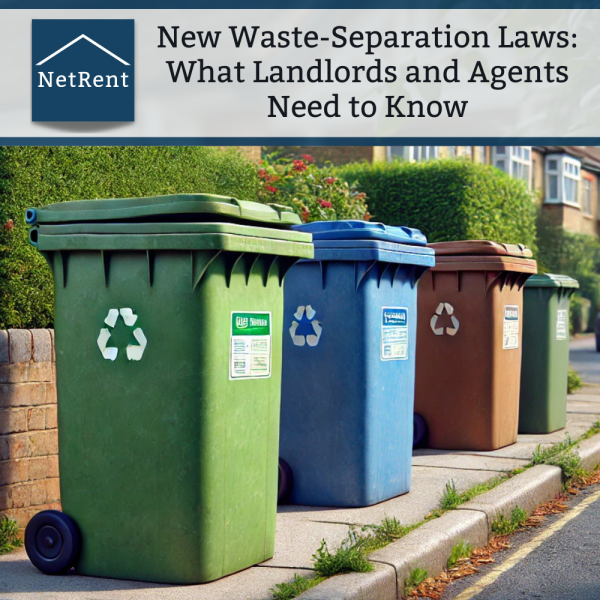
Major changes to waste-management rules are on the horizon — and they carry serious consequences for landlords and letting agents. Under the Government’s new Simpler Recycling scheme, multi-tenanted properties such as HMOs will soon face strict requirements on bin provision, waste-stream separation and tenant guidance. Failure to comply could result in fines of up to £5,000, and in serious cases, even criminal prosecution.
Below is a full breakdown of the new legislation, when it comes into force, and who will be affected.
What Is Changing?
From 31 March 2026, every local authority in England will be required to introduce the Simpler Recycling system. This means councils must collect at least four separate waste streams:
-
General waste
-
Food waste
-
Paper and card
-
Other dry recyclables (such as plastics, metals and glass)
For HMOs and other shared rental properties, this creates new legal duties. Landlords and agents will be expected to:
-
Provide the correct bins for all four waste categories
-
Ensure there is sufficient capacity to cope with tenant use
-
Give tenants clear written instructions on how to sort their waste
-
Put appropriate collection arrangements in place
One of the most significant changes is that waste contamination (e.g., tenants placing the wrong items in a bin) can be classed as a management failure. Even if the error is made by a tenant, enforcement action can still fall on the landlord or the managing agent.
When Will the New Rules Apply?
The national start date for the new system is 31 March 2026. From that point onward:
-
Councils must operate the four-stream collection service
-
Landlords and agents will be expected to have compliant bin systems in place
-
Tenants must be provided with waste-separation guidance
-
Councils can begin issuing penalties where properties fail to meet the standard
Breaches will normally lead to a warning first, but continued non-compliance may trigger fixed penalties of up to £5,000. In more serious cases — such as persistent failure to manage waste or health-and-safety risks arising from poor waste systems — landlords may face prosecution or consequences affecting their HMO licence.
Who Will Be Affected?
These changes will apply across the rental sector, but the impact will be greatest for:
Landlords of HMOs and Shared Properties
Higher occupancy levels mean more waste, greater risk of contamination and the need for stronger management. HMOs are already subject to enhanced standards, and poor waste control can put an HMO licence at risk.
Letting and Managing Agents
Agents who manage properties on behalf of landlords will share responsibility for compliance. If tenants mis-sort waste or bins overflow, enforcement action may be directed at the managing agent.
Tenants
While penalties will not fall on tenants directly, their cooperation will be essential. Tenants’ waste behaviour will now directly influence whether the property complies with the law.
Local Authorities
Councils must introduce the four-stream service and enforce the new rules, potentially issuing penalties where landlords fail to meet their responsibilities.
What Landlords and Agents Should Do Now
With the 2026 deadline approaching, early planning will be essential. Recommended steps include:
1. Audit Current Waste Provision
Check how many bins you currently have, how frequently they are collected and whether capacity will be sufficient once waste is separated.
2. Review and Upgrade Bin Systems
Ensure you have distinct bins for general waste, food waste, paper/card and mixed recyclables.
3. Create Clear Tenant Instructions
Produce written guidance explaining exactly what goes into each bin. This should be provided at the start of a tenancy and included in property handbooks or welcome packs.
4. Increase Tenant Communication
Good communication can reduce contamination. Consider using signage, bin-store posters or periodic reminders.
5. Prepare for Extra Cost and Administration
More bins may require more space, and some councils may charge for additional capacity. In heavy-use properties, private waste contractors may be necessary.
Why This Change Matters
The introduction of Simpler Recycling forms part of a much broader trend: increasing regulation within the private rented sector. Waste-management may previously have been seen as a tenant responsibility, but under the new framework it becomes a formal compliance obligation for landlords and agents.
With fines, possible prosecution and potential implications for HMO licensing, waste management must now be treated as a core part of property compliance — not an afterthought.
Conclusion
The new waste-separation rules coming into force in March 2026 represent a major operational shift for landlords and agents, particularly those managing HMOs. Preparing early — by reviewing bin systems, updating tenant guidance and ensuring adequate collection arrangements — will be essential to stay compliant and avoid penalties.