

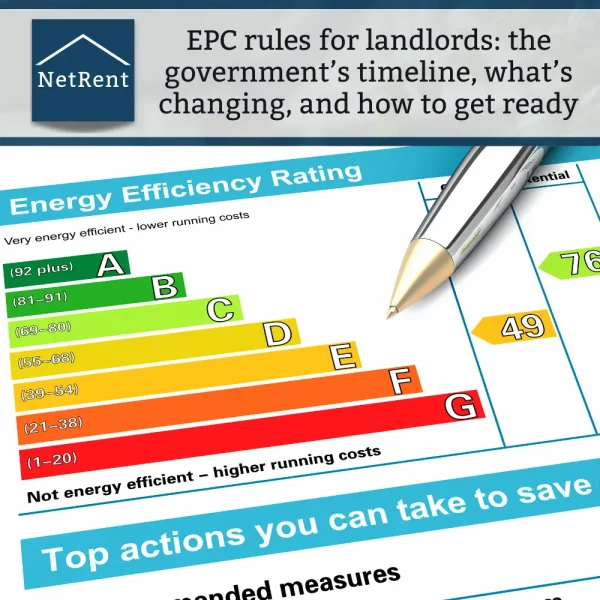
Energy Performance Certificates (EPCs) and Minimum Energy Efficiency Standards (MEES) have been on landlords’ radars for years. The direction of travel is now much clearer: England and Wales are moving toward a higher minimum standard equivalent to EPC “C” for privately rented homes by 2030, alongside a major reform of how EPCs are calculated and displayed.
This guide covers:
-
the government’s current timeline for new private rented sector (PRS) energy rules
-
how EPC reform affects compliance planning
-
a practical, step-by-step landlord action plan to meet the new requirements with the least disruption
The government’s timeline for EPC/MEES changes (England & Wales)
Now: MEES at EPC “E” remains the legal minimum
The existing MEES rules still apply: properties generally must meet EPC E or above (unless a valid exemption applies). The “E-to-C” policy is about what’s coming next — but landlords must stay compliant with current rules while preparing.
2026: EPC reform begins to land (methodology and the certificate itself)
The government is moving forward with reforms that replace the current EPC calculation approach with the Home Energy Model (HEM) and a redesigned EPC format. Instead of one simple headline number dominating decisions, new EPCs are expected to present several headline metrics (for example, fabric performance and heating system performance).
Importantly for landlords: the government’s published direction suggests new EPCs are targeted to start being delivered from October 2026, with further detail expected as implementation progresses.
2027: legal framework to update PRS regulations is targeted
Government materials indicate an intention to put in place the legal mechanism to update PRS regulations, aiming for the relevant statutory changes to come into force in 2027. This is the stage that enables the new PRS standard to be applied in law (with the compliance date still later).
1 October 2030: a single compliance date for all tenancies
The government’s latest stated approach is a single compliance date of 1 October 2030 for the PRS standard. Crucially, it indicates there will not be an earlier compliance date for new tenancies (i.e., no “new lets must comply first” rule).
A “grandparenting” window up to 1 October 2029
If your property achieves EPC C (or above) on the current system before 1 October 2029, it can be treated as compliant with the higher standard until that EPC expires or is replaced. This is a big practical opportunity for landlords: improving earlier can buy you time and reduce uncertainty during the EPC reform period.
Cost cap and exemptions: what landlords should expect
The government’s direction includes a maximum spend (“cost cap”) approach, plus exemptions where compliance isn’t feasible or appropriate. Key themes landlords should understand:
The cost cap is set at £10,000 (with an affordability adjustment)
The policy approach describes a £10,000 cost cap for required improvements, and also references an affordability-style adjustment linked to property value (for example, a cap equivalent to 10% of value, where lower).
Exemptions remain a major part of the system
Exemptions are expected to continue covering cases such as:
-
improvements exceeding the cap
-
“all relevant improvements made” but the property still doesn’t reach the target
-
third-party consent issues (tenant/leaseholder/freeholder/planning)
-
other circumstances where measures are not appropriate or possible
Evidence and auditability matter
Landlords should plan on needing clear documentation for:
-
improvement costs and invoices
-
relevant reports/assessments
-
correspondence showing consent attempts or refusals
-
why a measure wasn’t suitable (where applicable)
Early spending can count (from 1 October 2025)
The policy direction indicates that spending on relevant measures from 1 October 2025 onwards is intended to count toward the cap (within the rules), to encourage early action.
Grants: helpful, but may not count toward the cap in the same way
Where government grants are available (for example for low-carbon heating), the policy position highlights that grant amounts may not be counted as landlord spending toward the cap — but can still reduce your out-of-pocket cost substantially.
Why EPC reform changes how you should plan
A common mistake is assuming: “If I hit a C on today’s EPC, I’m done.”
In reality, the government is reforming what the EPC measures and how it’s displayed.
That said, the “grandparenting” approach gives a practical bridge:
-
Get to EPC C before 1 October 2029, and you’re treated as compliant until that EPC expires (or is replaced).
So a sensible strategy for many landlords is:
-
use today’s EPC to drive cost-effective upgrades now, and
-
stay flexible to re-assess under the new EPC if/when required.
What steps landlords should take to meet the new requirements
Step 1: Create an EPC/MEES register for your portfolio
For every property, record:
-
current EPC rating and score
-
EPC expiry date
-
tenancy type (single let / HMO / etc.)
-
constraints (listed building, conservation area, solid walls, off-gas, flat roof, etc.)
-
likely void periods between now and 2030
This will immediately show which homes are:
-
already at C (manage and maintain)
-
close to C (often the cheapest wins)
-
far from C (need earlier planning and budgeting)
Step 2: Prioritise “fabric first” upgrades
Even as EPCs evolve, improving the building’s fabric tends to remain valuable across methodologies and delivers real-world benefits for tenants.
Common “best value” measures often include:
-
loft insulation (including topping up)
-
cavity wall insulation (where suitable)
-
draught-proofing and air tightness improvements
-
hot water cylinder insulation / pipe lagging
-
glazing upgrades where appropriate (or secondary glazing in sensitive buildings)
Fabric-first upgrades also reduce condensation and damp risk in many cases (when paired with sensible ventilation), improve comfort, and can cut tenant bills.
Step 3: Improve heating controls and efficiency
Controls are often a strong “EPC uplift per £” lever:
-
thermostatic radiator valves (TRVs)
-
programmer/thermostat upgrades
-
zoning where feasible
-
smart controls (where appropriate)
If a boiler is nearing end-of-life, plan replacement strategically rather than reactively — especially if you’re also planning insulation upgrades, because sizing and system setup can change.
Step 4: Consider low-carbon heating where it makes sense
Heat pumps and other low-carbon options can be viable, but the right approach depends on the property.
Before committing, check:
-
insulation/airtightness readiness
-
radiator sizing and flow temperature requirements
-
outdoor unit location and planning considerations
-
electrical capacity and any needed upgrades
Where grants are available, they can transform the business case — but landlords should still prioritise measures that give predictable performance.
Step 5: Time works around tenancies to reduce disruption and void time
Some measures are easy in-tenancy (controls, minor draught-proofing), while others are best during voids (insulation works, major heating changes).
Practical tips:
-
plan invasive works for void periods wherever possible
-
communicate early with tenants (comfort and bills are persuasive)
-
document all consent conversations and access attempts
Step 6: Budget against the cap — and don’t leave it to 2029/2030
Even with a 2030 compliance date, last-minute rushes tend to create:
-
higher labour and materials costs
-
longer lead times for installers
-
rushed decisions and poorer outcomes
-
extended void periods
A staged plan spreads spend and reduces risk.
Step 7: Build a “compliance folder” per property
Start compiling evidence now:
-
EPCs (historic and current)
-
invoices and installation certificates
-
photos before/after (especially insulation)
-
consent correspondence
-
any exemption applications and supporting documentation
If enforcement tightens closer to 2030, you’ll be ready.
Quick FAQs
Do new tenancies have to comply earlier than 2030?
The current stated approach is a single compliance date of 1 October 2030, not an earlier date for new tenancies.
If I’m already EPC C, do I need to do anything?
If you have an EPC showing C or above obtained before 1 October 2029, it can be treated as compliant until that EPC expires (or is replaced). Still, keep an eye on expiry dates and consider further improvements during refurb cycles.
Is it definitely “EPC C”, or could the target shift?
The government describes the future PRS standard as equivalent to EPC C, but it is also reforming EPC methodology and metrics. That’s why fabric-first measures and good documentation are the safest bets.
The bottom line
-
2026: EPC reform starts to roll out (new methodology and new format)
-
2027: the legal mechanism to update PRS rules is targeted
-
By 1 Oct 2030: PRS homes in scope are expected to meet the higher standard (or hold a valid exemption)
-
Best move for many landlords: plan upgrades early, prioritise fabric and controls, and use the 2025–2029 window to lock in compliance where possible
Telephone: 01352 721300
Email: support@netrent.co.uk
Disclaimer: NetRent does not provide legal advice. This article represents our understanding of rental property law and government publications at the time of writing.