

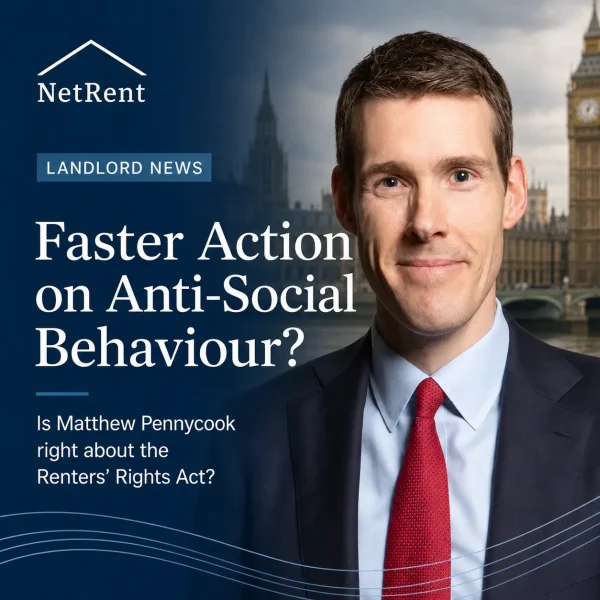
Matthew Pennycook says the Renters’ Rights Act gives landlords stronger tools to deal with anti-social behaviour. On paper, he has a point. In practice, the answer depends on evidence, court capacity and how quickly landlords act when problems begin.
Anti-social behaviour is one of the most difficult issues a landlord can face.
It can damage property, frighten neighbours, disrupt communities and leave landlords caught between angry residents, vulnerable tenants, managing agents, councils and the police.
So when Housing Minister Matthew Pennycook says the Renters’ Rights Act allows landlords to move faster in anti-social behaviour cases, landlords will understandably want to know whether that is really true.
The short answer is: yes, in some cases.
But it is not a magic wand.
The new system may allow landlords to move to court more quickly where serious anti-social behaviour is involved. However, success will still depend on the strength of the evidence, the legal ground used, the seriousness of the behaviour and the ability of the court system to deal with claims promptly.
In other words, landlords may have a faster route on paper — but they will still need to build a strong case.
Why this matters after Section 21
The Renters’ Rights Act ends Section 21 in England.
That is the major shift behind this whole debate.
Under the old system, many landlords dealing with difficult tenants could choose to use Section 21 rather than get into the detail of proving anti-social behaviour in court. It was often seen as simpler, cleaner and less confrontational.
Once Section 21 is gone, landlords will need to rely on specific legal grounds for possession.
That means if a landlord wants possession because of anti-social behaviour, they will need to use the relevant Section 8 grounds and show why those grounds apply.
This is where Matthew Pennycook’s argument comes in. The Government says landlords will not be left powerless. Instead, they will have grounds available to deal with serious nuisance, criminality and anti-social behaviour.
But landlords are right to ask whether those grounds will be strong enough in real life.
The key difference: Ground 14 and Ground 7A
Anti-social behaviour cases are likely to focus mainly on two routes: Ground 14 and Ground 7A.
Ground 14 is the established anti-social behaviour ground. It can be used where a tenant, or someone living in or visiting the property, has caused nuisance, annoyance, distress or used the property for illegal or immoral purposes.
The advantage of Ground 14 is that it can cover a wide range of behaviour. Noise nuisance, harassment, intimidation, threats, criminal behaviour, drug-related issues, serious neighbour complaints and other disruptive conduct may all be relevant.
The important point is that landlords can move to court quickly under Ground 14. There is no long waiting period before issuing proceedings.
But Ground 14 is discretionary. That means the court must decide whether it is reasonable to make a possession order.
That is a crucial limitation.
Even if the landlord proves anti-social behaviour, the court still has to consider the circumstances. The judge may look at the seriousness of the incidents, the impact on neighbours, whether the tenant has changed their behaviour, whether warnings were given, whether support was offered, and whether eviction is proportionate.
So Ground 14 may be quick to start, but it is not guaranteed to succeed.
Ground 7A is different.
Ground 7A is a mandatory ground linked to serious anti-social behaviour where certain conditions are met. This could include serious criminal offences, injunctions, closure orders, breach of noise abatement notices or serious riot-related behaviour.
If the legal conditions are properly satisfied, the court has much less discretion. That can make Ground 7A a stronger route in the most serious cases.
But there is a catch: it only applies where the specific trigger conditions are met.
For many everyday anti-social behaviour complaints, Ground 7A may not be available. A tenant who is noisy, intimidating or disruptive may cause real misery for neighbours, but unless the case fits the legal requirements, the landlord may still need to rely on Ground 14.
Is Pennycook right?
Pennycook is right to say the Renters’ Rights Act gives landlords routes to act against anti-social behaviour.
He is also right that in some cases landlords may be able to move straight to court more quickly than many people realise.
But the wider claim needs careful handling.
The Act does not mean every anti-social behaviour case will be fast. It does not mean landlords can simply remove a tenant because neighbours complain. And it does not remove the need for evidence.
The biggest practical issue is that anti-social behaviour is often messy.
Neighbours may be frightened to give statements. Police may not attend every incident. Noise may happen late at night with little formal record. Tenants may deny everything. Complaints may be inconsistent. Some cases involve mental health, addiction, domestic abuse or vulnerability.
Landlords cannot simply rely on frustration or hearsay. They need proof.
That means dates, times, incident logs, witness statements, police reference numbers, council reports, photographs, videos, audio evidence where appropriate, correspondence, warnings and records of attempts to resolve the problem.
The stronger the evidence, the stronger the case.
Faster action starts before court
One of the most important lessons for landlords is that “moving faster” does not begin when the court papers are issued.
It begins when the first complaint is made.
Landlords and letting agents should have a clear anti-social behaviour process. That process should include logging complaints properly, contacting the tenant quickly, asking neighbours for written records, involving the managing agent where relevant, contacting the council or police where appropriate, and keeping a full audit trail.
A vague complaint made months earlier is much harder to rely on than a detailed record built from the start.
For example, a landlord who can show repeated complaints, written warnings, police involvement, council noise reports and continued behaviour after intervention is in a much stronger position than a landlord who simply says “the neighbours have had enough”.
This is where professional management matters.
The court will want evidence, not emotion.
The court system remains the weak point
Even if the law allows landlords to act quickly, the courts may still slow things down.
This is one of the biggest concerns for landlords.
Possession claims already take time. Court delays vary by area, and landlords can face long waits for hearings, paperwork, orders and enforcement.
So while the Renters’ Rights Act may allow an anti-social behaviour claim to be started quickly, that does not always mean possession will be recovered quickly.
This is especially important where neighbours are living with serious nuisance or intimidation. A landlord may do everything correctly and still be waiting for the court process to catch up.
That is why many in the sector argue that the success of the Renters’ Rights Act depends not only on the wording of the legislation, but on whether the court system has the resources to cope.
A stronger possession ground is only useful if landlords can actually use it in a reasonable timeframe.
Good landlords need protection too
Most landlords do not want to evict tenants unnecessarily.
Eviction is expensive, stressful and often the last resort. Many landlords would rather resolve a problem if they can.
But serious anti-social behaviour is different.
When one household is making life miserable for neighbours, damaging the property or putting others at risk, landlords need a realistic route to act.
This matters not just for landlords, but for communities.
If landlords cannot deal with serious anti-social behaviour, neighbouring tenants and homeowners may feel abandoned. Good tenants may leave. Blocks of flats can deteriorate. Letting agents can become trapped in constant complaint handling. Property values and local confidence can suffer.
Tenant protection should not mean protecting serious nuisance.
The challenge is to balance security for renters with a fair and workable route for landlords when behaviour becomes unacceptable.
What landlords should do now
Landlords should not wait until a serious problem arises before thinking about anti-social behaviour.
They should review their tenancy documents, management processes and evidence-gathering procedures now.
It is sensible to have clear clauses dealing with nuisance, noise, harassment, illegal use, damage, visitors and behaviour affecting neighbours. Landlords should also make sure tenants understand these obligations at the start of the tenancy.
Where complaints arise, landlords should act early.
That does not always mean rushing to court. It may mean speaking to the tenant, issuing a warning, involving the agent, contacting the council, asking neighbours to keep incident diaries or encouraging reports to the police where criminal behaviour is alleged.
The key is to create a paper trail.
If the behaviour stops, the issue may be resolved. If it continues, the landlord has a better foundation for formal action.
Letting agents will play a bigger role
Letting agents are likely to become even more important under the new system.
Once Section 21 is no longer available, possession cases will become more evidence-led. That puts pressure on agents to document problems carefully and advise landlords when a situation is escalating.
Agents may need to be more proactive in gathering complaints, recording warnings, liaising with neighbours and ensuring landlords understand the risks of delay.
They will also need to avoid overpromising.
Telling a landlord that anti-social behaviour can be dealt with quickly may be true in some cases, but not all. The right advice will depend on the facts, the evidence and the ground being used.
Good agents will help landlords understand the difference between a difficult tenant, a breach of tenancy and a legally strong possession case.
The risk of false confidence
The danger in Pennycook’s message is that some landlords may believe the Renters’ Rights Act gives them a simple fast-track eviction route for all anti-social behaviour.
It does not.
Ground 14 still requires the court to decide whether possession is reasonable. Ground 7A is stronger, but only applies in more serious cases where specific legal conditions are met.
That means landlords still need discipline, patience and evidence.
A rushed, poorly prepared claim could fail. That would waste time, increase costs and leave the problem unresolved.
The better approach is to act quickly, but not carelessly.
Speed should come from early intervention and organised evidence, not from assuming the court will automatically agree.
So, will landlords be able to move faster?
In some cases, yes.
Where the anti-social behaviour is serious, well evidenced and fits the correct legal ground, landlords should have a route to act without waiting for a long notice period.
Where Ground 7A applies, the landlord’s position may be significantly stronger than under a purely discretionary ground.
But many cases will still depend on Ground 14. That means the court will weigh the evidence and decide whether possession is reasonable.
So the real answer is this: the Renters’ Rights Act may give landlords a quicker starting point, but not always a quicker finish.
The law may help, but the practical outcome will depend on evidence, process and court capacity.
The bottom line
Matthew Pennycook is partly right.
The Renters’ Rights Act does preserve and strengthen routes for landlords dealing with anti-social behaviour. It does not leave landlords helpless after Section 21.
But landlords should not mistake political reassurance for a guaranteed quick result.
Anti-social behaviour cases will still need proper evidence, careful handling and, in many cases, a court decision. The serious cases may move more firmly and more quickly, especially where Ground 7A applies. The more common nuisance cases may still be difficult, contested and slow.
For landlords and letting agents, the message is simple: do not wait for the problem to spiral.
Record everything. Act early. Communicate clearly. Involve the right authorities where needed. Build the evidence from day one.
Under the Renters’ Rights Act, landlords may have the tools to move faster — but only if they are ready to use them properly.
Disclaimer: NetRent does not provide legal advice. This article reflects our understanding of rental property law and current market developments. Landlords should seek independent professional advice before making decisions about their property, tenancy or compliance obligations.
Telephone: 01352 721300
Email: support@netrent.co.uk