

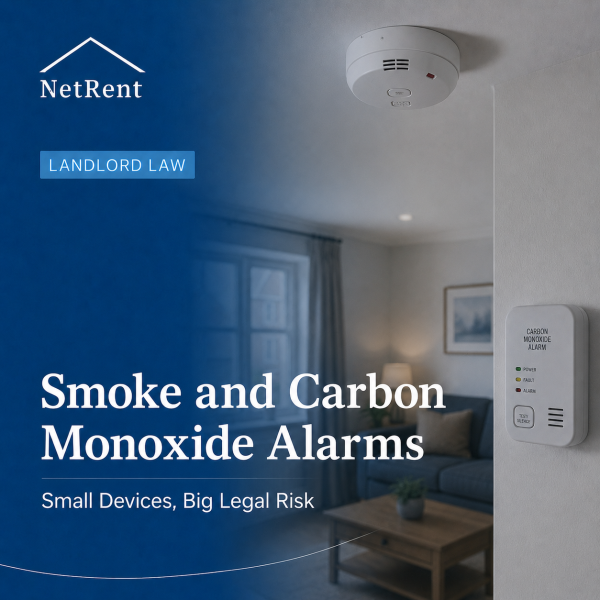
Smoke and carbon monoxide alarms are small, relatively inexpensive devices, but they carry major importance for residential landlords.
They are not optional extras. They are part of the basic safety framework for rented homes in England.
A missing alarm, faulty alarm or lack of evidence that alarms were checked can create serious risk for tenants and significant problems for landlords.
The key message is simple: landlords need the right alarms, in the right places, working at the right time.
What landlords must provide
Landlords must make sure rented homes have appropriate smoke and carbon monoxide alarms.
In broad terms, landlords in England need to ensure:
- at least one smoke alarm is fitted on every storey used as living accommodation;
- a carbon monoxide alarm is fitted in any room used as living accommodation that contains a fixed combustion appliance;
- gas cookers are excluded from the carbon monoxide alarm requirement;
- alarms are working at the start of the tenancy;
- faulty alarms are repaired or replaced once the tenant reports a problem.
This means landlords should think about the whole property, not just the kitchen or hallway.
Smoke alarms
Smoke alarms are required on every storey of the property where there is a room used as living accommodation.
This may include:
- ground floor;
- first floor;
- converted loft space;
- basement accommodation;
- split-level living areas.
A landlord should consider the layout of the property carefully. A three-storey house may need more alarms than a simple one-bedroom flat.
The law sets the basic minimum, but landlords should also think practically about whether the alarm coverage is sensible for the property.
Carbon monoxide alarms
Carbon monoxide alarms are required in rooms used as living accommodation where there is a fixed combustion appliance.
This can include rooms with:
- gas boilers;
- oil boilers;
- gas fires;
- wood burners;
- log burners;
- coal fires;
- other fixed combustion appliances.
Gas cookers are excluded from this specific requirement, but landlords should still take gas safety seriously throughout the property.
Carbon monoxide is especially dangerous because it cannot be seen or smelled. Symptoms can be mistaken for tiredness, illness or flu-like conditions. A working alarm can save lives.
Working at the start of the tenancy
Landlords must make sure alarms are in proper working order at the start of the tenancy.
This is a point many landlords overlook.
It is not enough to assume an alarm worked during the previous tenancy. Alarms can be removed, damaged, run out of battery or reach the end of their useful life.
Landlords should test alarms at the start of each tenancy and keep a record.
Useful evidence may include:
- a signed check-in document;
- dated photographs;
- inventory notes;
- agent confirmation;
- tenant acknowledgement;
- property management system records.
The aim is to be able to show that alarms were present and working when the tenancy began.
What happens during the tenancy?
During the tenancy, tenants will usually be expected to use the alarms properly and report faults.
However, once a tenant tells the landlord that an alarm is faulty, the landlord must act.
The landlord should repair or replace the alarm as soon as reasonably possible.
This means landlords should take reports seriously, especially where a tenant says:
- an alarm is not sounding when tested;
- a battery cannot be replaced;
- the alarm is damaged;
- the alarm keeps sounding without reason;
- an alarm is missing;
- a carbon monoxide alarm has activated.
Reports should be logged, responded to and resolved promptly.
Battery alarms or mains-wired alarms?
The rules do not always require mains-wired alarms in every case, but landlords should think carefully about what is appropriate for the property.
Battery alarms may be acceptable in many homes, but they create reliance on batteries being maintained. Sealed long-life battery alarms may reduce that risk.
Mains-wired alarms may be more suitable in some properties, especially larger homes, HMOs or properties with higher fire safety risks.
Landlords should also check whether other rules apply, particularly where the property is an HMO or part of a larger building.
HMOs and higher-risk properties
The basic smoke and carbon monoxide alarm rules are not the only fire safety rules landlords may need to consider.
HMOs, converted buildings, blocks of flats and properties with shared areas may have additional fire safety duties.
These may involve:
- fire risk assessments;
- emergency lighting;
- fire doors;
- heat detectors;
- interlinked alarms;
- fire blankets or extinguishers where appropriate;
- escape routes;
- management of communal areas;
- licence conditions.
Landlords should not assume that meeting the basic alarm rules is enough for every property type.
Evidence matters
As with many landlord duties, the practical issue is often evidence.
A landlord may believe alarms were installed and checked, but if there is no record, it may be harder to prove later.
Landlords should keep records showing:
- where alarms are installed;
- type of alarm;
- installation date if known;
- expiry or replacement date;
- start-of-tenancy testing;
- tenant reports of faults;
- repair or replacement action;
- contractor or agent notes;
- photographs where useful.
This information can sit within the wider property compliance file alongside gas safety, electrical safety, EPC, deposit and tenancy documents.
Enforcement and penalties
Local authorities can take action where landlords fail to comply with smoke and carbon monoxide alarm duties.
If a landlord fails to act after being required to do so, the council may arrange remedial action and financial penalties can follow.
The financial penalty can be significant, but the bigger issue is tenant safety. A landlord who neglects alarm duties may also face wider consequences if a fire or carbon monoxide incident occurs.
Why this matters under the Renters’ Rights Act
The Renters’ Rights Act has made landlord records, property condition and tenant safety even more important.
Smoke and carbon monoxide alarms are likely to be viewed as basic compliance documents within the wider move towards clearer landlord accountability.
Future reforms, including the PRS Database, Landlord Ombudsman and stronger property condition standards, all point in the same direction: landlords need to be able to show that homes are safe and properly managed.
Alarm records may seem minor, but they can form part of that wider compliance picture.
Common landlord mistakes
1. Assuming one alarm is enough
A property may need alarms on multiple storeys and carbon monoxide alarms in specific rooms.
2. Forgetting to test at the start of the tenancy
Landlords should check and record that alarms are working when the tenancy begins.
3. Ignoring tenant reports
Faulty alarms should be repaired or replaced promptly once reported.
4. Forgetting carbon monoxide alarms
Rooms with fixed combustion appliances may need carbon monoxide alarms.
5. Treating gas cookers incorrectly
Gas cookers are excluded from the specific carbon monoxide alarm requirement, but landlords should still manage gas safety properly.
6. Overlooking HMOs
HMO and licensing rules may require more than the basic alarm setup.
7. Keeping no records
Evidence of installation and testing is important.
Practical checklist for landlords
Landlords should:
- check every storey has a smoke alarm where required;
- check rooms with fixed combustion appliances for carbon monoxide alarm requirements;
- remember that gas cookers are excluded from the specific CO alarm requirement;
- test alarms at the start of each tenancy;
- record the test;
- include alarms in the inventory or check-in report;
- respond promptly to tenant reports of faults;
- replace expired or damaged alarms;
- check HMO or licence conditions;
- keep alarm records in the property compliance file;
- review alarm coverage after property alterations;
- make sure agents know the process.
The key takeaway
Smoke and carbon monoxide alarms are simple devices, but they are central to tenant safety and landlord compliance.
Landlords need to make sure the right alarms are fitted, working at the start of the tenancy and repaired or replaced if faults are reported.
In the new rental landscape, good records matter as much as good intentions.
A working alarm may be small, but the risk of getting this wrong is anything but.
NetRent does not provide legal advice. This article represents our understanding of rental property law at the time of writing.
Telephone: 01352 721300
Email: support@netrent.co.uk