

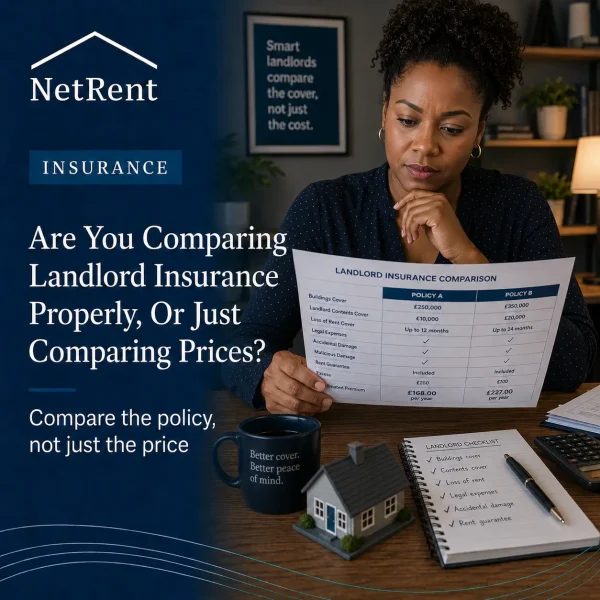
When landlords compare insurance, the premium often gets most of the attention.
That is understandable. The price is clear, immediate and easy to compare. One quote is higher, one is lower, and one may appear to offer an obvious saving.
But landlord insurance should not be compared on price alone.
A cheaper quote may be better. It may be the result of better broking, a more competitive insurer, a more suitable product or a proper review of the market.
But it may also be cheaper because the cover is weaker, the excesses are higher, the policy conditions are stricter, or the quote is based on assumptions that do not properly reflect the landlord’s property or portfolio.
The real question is not simply:
“Which quote is cheapest?”
The better question is:
“Which policy gives me the right protection at the right price?”
Landlord insurance is not all the same
It is easy to assume that landlord insurance policies are broadly similar.
They may all use similar words. Buildings cover. Liability. Loss of rent. Accidental damage. Malicious damage. Legal expenses. Excesses. Optional extras.
But the detail can vary significantly.
Two policies can both be described as landlord insurance but provide very different levels of protection. One may deal with loss of rent more favourably. One may have a much higher excess. One may include malicious damage by tenants on better terms. One may have stricter unoccupancy conditions. One may be based on a more accurate understanding of the tenant type, property use and risk.
That is why landlords need to compare the policy, not just the premium.
What should landlords compare?
A proper landlord insurance comparison should look at the areas that actually matter if something goes wrong.
That includes:
- buildings cover
- contents cover, where required
- loss of rent
- malicious damage by tenants
- accidental damage
- liability cover
- legal expenses, where required
- unoccupancy conditions
- policy excesses
- exclusions
- endorsements
- claims process
- sum insured values
- tenant type
- previous claims history
- material facts
- whether the policy is suitable for the property or portfolio
If these details are not checked, the landlord is not really comparing insurance properly.
They are comparing prices.
Price is simple. Suitability is more important.
A low premium can look appealing, especially when costs are rising across the private rented sector.
But suitability matters more than a headline saving.
If the policy does not reflect the property correctly, the landlord may have a problem. If the tenant type has not been disclosed accurately, the landlord may have a problem. If the sum insured is too low, the landlord may have a problem. If an exclusion applies to the very risk the landlord thought was covered, the landlord may have a problem.
These issues may not be obvious from the premium.
They are found by reviewing the detail.
A matched quote still needs checking
This also matters when a landlord receives a quote from NetRent and Clear, then takes it back to their existing broker.
The existing broker may offer to match the premium.
But has the policy been matched?
That is the question landlords should ask.
A matched price is not always a matched policy. The cover may not be the same. The excesses may not be the same. The loss of rent provision may not be the same. Malicious damage terms may not be the same. Unoccupancy conditions may not be the same. The claims support may not be the same.
If your existing broker can suddenly match the price, you should also ask why that was not offered at renewal in the first place.
A landlord should not accept a matched premium until the policy itself has been properly compared.
Good comparison starts with good questions
The quality of a landlord insurance quote depends on the quality of the information behind it.
Good comparison starts with proper questions.
- What type of property is being insured?
- Who lives there?
- Has the tenant type changed?
- Is the property ever empty?
- Is it an HMO?
- Is it part of a portfolio?
- Has the property been altered or refurbished?
- Is the sum insured still accurate?
- Has there been any previous damage or claims history?
- Are there any material facts that need to be disclosed?
If these questions are not asked, the quote may not properly reflect the risk. That can make any comparison unreliable.
The cheapest quote based on incomplete information may not be the best quote.
Portfolio landlords need a deeper comparison
For portfolio landlords, proper comparison is even more important.
A landlord with five, ten, fifteen or more properties may have different property types, different tenant types, different sums insured, different risks and different levels of rent across the portfolio.
Looking only at the total premium can be misleading.
The portfolio needs to be reviewed properly. The cover should be checked across the whole arrangement. The landlord should understand whether the policy is competitive, but also whether it is suitable.
For portfolio landlords, the wrong insurance decision can affect more than one property. That makes proper comparison essential.
Why NetRent and Clear focus on proper review
NetRent has worked with landlords for 23 years. We understand rental property and the practical issues landlords face when arranging insurance.
Our role is to speak to landlords, understand the property or portfolio, ask the right questions and pass properly considered information to Clear’s dedicated NetRent insurance team.
Clear Insurance Management then use their specialist broking expertise to review the details and seek appropriate landlord insurance options.
Importantly, Clear do not simply roll policies forward at renewal. They re-broke landlord insurance to help ensure landlords are getting the best available price and policy for their circumstances.
That approach matters because proper comparison is not just about finding a cheaper number. It is about finding the right balance of price, cover and suitability.
Do not let the premium make the whole decision
The premium matters. No landlord wants to pay more than necessary.
But the premium should not be allowed to make the whole decision.
Before renewing, landlords should ask:
- Is the cover suitable?
- Are the excesses acceptable?
- Is loss of rent cover adequate?
- Are malicious damage risks dealt with properly?
- Are unoccupancy conditions clear?
- Has the tenant type been disclosed correctly?
- Has the market been properly reviewed?
- Is the broker actively working for my business, or simply assuming I will renew?
Those questions are far more useful than simply asking which quote is cheapest.
Contact NetRent before you renew
If your landlord insurance renewal is approaching, do not compare price alone.
Send your renewal to NetRent before you commit.
Let us review what you have been offered. Let us ask the right landlord-specific questions. Let us see whether Clear’s dedicated NetRent team can provide a competitive alternative that properly reflects your property or portfolio.
You may save money. You may improve your cover. You may discover that the quote you were about to accept was not truly comparable.
But most importantly, you will be making a more informed decision.
Call NetRent: 01352 721300
Email: insurance@netrent.co.uk
Before you renew, compare the policy, not just the price. Send your landlord insurance renewal to NetRent.