

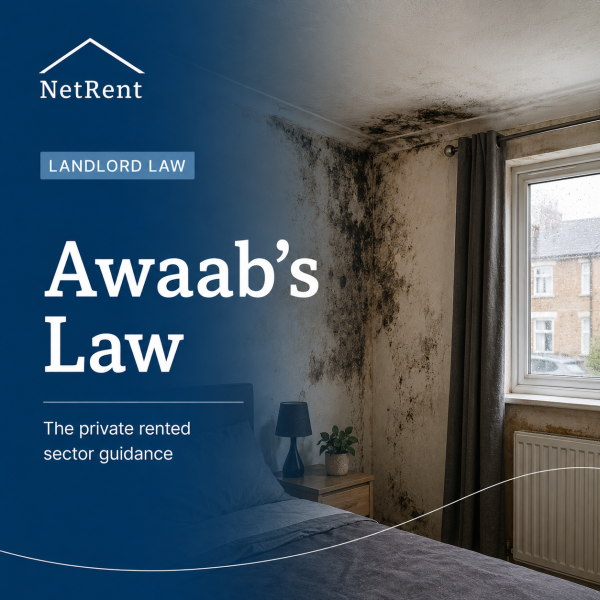
Awaab’s Law is one of the most important housing condition reforms landlords need to understand.
It was introduced following the tragic death of two-year-old Awaab Ishak, who died after prolonged exposure to mould in his home. The case placed national attention on how landlords respond to serious hazards, especially damp and mould.
Awaab’s Law currently applies in the social housing sector, but the Renters’ Rights Act will extend its principles to the private rented sector.
For private landlords, this signals a major change in expectations around repairs, hazards, complaints and response times.
The key message is simple: serious hazards will need a faster, clearer and more evidence-based response.
What is Awaab’s Law?
Awaab’s Law is designed to make landlords deal with serious housing hazards within set timescales.
The aim is to stop dangerous conditions being ignored, delayed or treated as routine maintenance.
Although the private rented sector detail is still to be confirmed, the direction is clear. Landlords should expect stronger rules around:
- investigating serious hazards;
- responding to tenant complaints;
- carrying out urgent repairs;
- documenting action taken;
- communicating with tenants;
- proving that hazards have been dealt with.
This is particularly relevant for damp, mould, excess cold, heating failures, leaks, unsafe electrics and other conditions that may affect health and safety.
Why private landlords need to pay attention
Some landlords may think Awaab’s Law is only a social housing issue.
That would be a mistake.
The Renters’ Rights Act is expected to bring Awaab’s Law into the private rented sector as part of a wider push to improve housing standards.
This means private landlords should prepare for a system where serious hazards are not handled at a casual pace.
In future, landlords may need to show that they acted within required timescales and kept clear records at each stage.
What problems could fall within the rules?
The final private rented sector rules have not yet been confirmed, but landlords should expect the focus to be on hazards that can affect health and safety.
This may include:
- damp and mould;
- excess cold;
- loss of heating;
- loss of hot water;
- serious leaks;
- unsafe electrics;
- fire safety issues;
- structural risks;
- pest infestations;
- sanitation problems;
- dangerous stairs or floors;
- poor ventilation;
- severe condensation linked to property defects.
Not every repair issue will be treated the same way. A minor decorative problem is not the same as black mould in a child’s bedroom or a heating failure during winter.
The seriousness of the hazard will matter.
Damp and mould will be central
Awaab’s Law is strongly associated with damp and mould.
That does not mean every mould complaint will automatically be treated as the landlord’s fault. However, it does mean landlords should take complaints seriously and investigate properly.
A landlord should not simply reply by telling the tenant to open windows or use less heating.
Damp and mould may be linked to:
- leaks;
- roof defects;
- poor ventilation;
- inadequate heating;
- cold bridging;
- defective windows;
- blocked gutters;
- rising damp;
- penetrating damp;
- plumbing issues;
- poor insulation;
- overcrowding or use of the property.
Tenant behaviour can sometimes be relevant, but landlords should avoid making assumptions without evidence.
The importance of inspection
Under a stricter repair regime, inspection will become more important.
Where a tenant reports damp, mould, leaks, heating failure or another serious issue, landlords should consider whether an inspection is needed.
An inspection should look at:
- what the tenant has reported;
- when the problem started;
- where the problem is located;
- whether there are visible hazards;
- whether the problem is worsening;
- whether any vulnerable occupiers are affected;
- whether temporary action is needed;
- what repair work is required;
- whether a specialist contractor is needed.
Landlords should keep written inspection notes and photographs where appropriate.
Response times will matter
The private rented sector version of Awaab’s Law is expected to introduce clearer timescales.
The exact deadlines for private landlords are still subject to consultation, but the overall direction is that serious hazards should be investigated and addressed quickly.
This means landlords should prepare systems now.
They should know:
- how tenants report urgent issues;
- who checks those reports;
- who decides whether something is urgent;
- which contractors can attend quickly;
- how tenant communication is recorded;
- how repair completion is evidenced;
- what happens if access is refused;
- how temporary works are followed up.
A landlord who only reacts slowly after repeated tenant complaints may face greater risk once the new rules are in force.
Written records will become essential
Awaab’s Law is not just about doing the repair. It is also about being able to prove what happened.
Landlords should keep records of:
- the tenant’s original complaint;
- dates and times of reports;
- photographs or videos supplied by the tenant;
- landlord or agent responses;
- inspection dates;
- inspection notes;
- contractor instructions;
- contractor reports;
- quotes;
- works ordered;
- works completed;
- access attempts;
- delays and reasons;
- tenant updates;
- follow-up checks.
Good records can show that the landlord took the issue seriously.
Poor records may make it harder to defend a complaint, council investigation or Ombudsman referral.
Access problems
Access can be one of the hardest practical issues.
A landlord may arrange a contractor, but the tenant may not be available, may miss appointments or may refuse access.
That does not mean the landlord should give up.
Landlords should document:
- appointment offers;
- notices given;
- tenant responses;
- missed appointments;
- rearranged visits;
- contractor attendance notes;
- any refusal of access;
- further attempts to resolve the issue.
If a serious hazard is reported, access problems should be managed carefully and professionally.
Temporary measures
Sometimes a permanent repair cannot be completed immediately.
For example, a boiler part may need ordering, a roof repair may depend on weather, or a leak may need further investigation.
In those cases, landlords should consider temporary measures.
This might include:
- making the area safe;
- stopping an active leak;
- providing temporary heating;
- arranging dehumidifiers where appropriate;
- improving ventilation temporarily;
- isolating unsafe equipment;
- arranging alternative facilities in serious cases.
Temporary measures should not become permanent substitutes for proper repairs.
Vulnerable tenants
The impact of hazards can be more serious where tenants are vulnerable.
Landlords should be alert to households with:
- young children;
- older people;
- disabled occupants;
- pregnant tenants;
- people with asthma or respiratory conditions;
- people with serious health conditions.
A hazard that might already be concerning can become more urgent where it affects a vulnerable occupant.
Landlords should record any relevant information tenants provide and consider whether the response needs to be escalated.
How this links to the Decent Homes Standard
Awaab’s Law will not sit alone.
It is expected to form part of a wider move to raise standards in the private rented sector, alongside the proposed Decent Homes Standard.
Together, these reforms point towards a more regulated approach to property condition.
Landlords should expect greater attention on:
- serious hazards;
- property condition;
- repair timescales;
- complaint handling;
- tenant safety;
- evidence and records;
- local authority enforcement;
- future Ombudsman oversight.
This is why landlords should treat property condition as a core compliance issue, not just routine maintenance.
Why landlords should prepare now
Even though the final private rented sector details are still awaited, landlords do not need to wait before improving their processes.
Preparation now may reduce risk later.
Landlords should review:
- how repairs are reported;
- how urgent issues are identified;
- how damp and mould complaints are handled;
- contractor availability;
- inspection procedures;
- record-keeping systems;
- tenant communication templates;
- agent reporting processes;
- follow-up procedures;
- emergency contact arrangements.
If an agent manages the property, landlords should still understand what process the agent uses.
Common landlord mistakes
1. Treating damp and mould as minor
Damp and mould can have serious health implications and should be investigated properly.
2. Blaming the tenant too quickly
Tenant behaviour may be relevant, but assumptions without inspection can be risky.
3. Failing to record complaints
If a tenant reports a serious hazard, the date and response should be recorded.
4. Waiting too long to inspect
Serious hazards should not sit unanswered for weeks.
5. Not following up temporary repairs
A temporary fix should be tracked until the permanent issue is resolved.
6. Poor communication
Tenants should be told what is happening, when contractors are attending and what the next step is.
7. Assuming the agent has dealt with it
Landlords should make sure they receive evidence of repairs and completion.
Practical checklist for landlords
Landlords should:
- review repair reporting procedures;
- create a clear process for urgent hazards;
- treat damp and mould complaints seriously;
- inspect where the cause is unclear;
- keep photographs and inspection notes;
- use competent contractors;
- record tenant communications;
- document access attempts;
- follow up temporary repairs;
- prioritise vulnerable households;
- keep completion evidence;
- review agent procedures;
- prepare for future statutory timescales.
The key takeaway
Awaab’s Law represents a shift towards faster, more accountable responses to serious housing hazards.
For private landlords, the final detail is still to come, but the direction is already clear.
Landlords should expect stricter expectations around damp, mould, heating failures, serious hazards, tenant complaints and repair records.
The best preparation is to act now: respond promptly, investigate properly, communicate clearly and keep evidence.
In the next phase of private rented sector reform, good repair management will not just be good practice. It will be central to landlord compliance.
NetRent does not provide legal advice. This article represents our understanding of rental property law at the time of writing.
Telephone: 01352 721300
Email: support@netrent.co.uk