

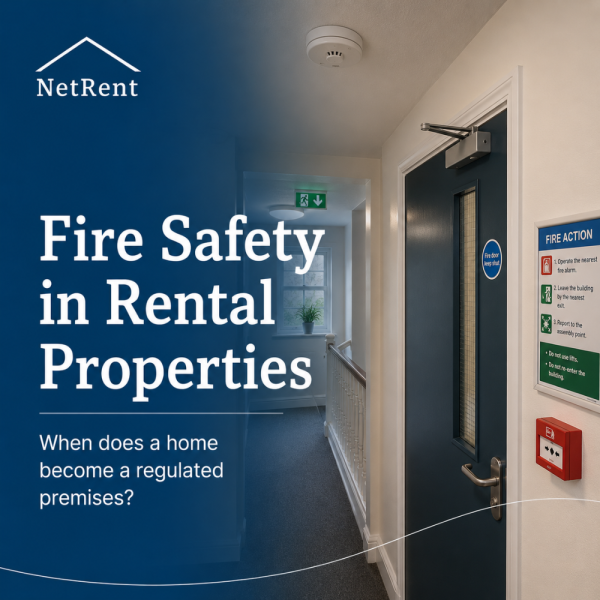
Fire safety is one of the most important areas of landlord compliance.
For many landlords, the focus is on smoke alarms, carbon monoxide alarms, electrical safety and keeping escape routes clear. Those duties matter, but fire safety can become more complicated where a property is not simply a single household living in a self-contained home.
HMOs, converted buildings, blocks of flats and properties with shared or common areas can bring additional responsibilities.
The key message is simple: fire safety duties depend on the type of property, how it is occupied and whether any parts of the building are shared or controlled by the landlord or another responsible person.
Why fire safety matters
Fire safety is not just a paperwork issue.
A fire can cause injury, death, major property damage, insurance problems, enforcement action and serious financial consequences.
Landlords should treat fire safety as a core part of property management, especially where there are multiple occupiers, shared escape routes or common areas.
A single-family let may involve one level of responsibility. An HMO or block of flats may involve much more.
Basic fire safety duties for landlords
Every landlord should think about fire safety in the rental property.
This may include:
- smoke alarms;
- carbon monoxide alarms where required;
- safe electrical installations;
- safe gas appliances;
- safe heating systems;
- safe supplied appliances;
- compliant furniture and furnishings where provided;
- clear escape routes;
- suitable doors and windows where they form part of escape;
- tenant information;
- records of checks, repairs and inspections.
Even where the more formal fire safety regime does not apply in the same way, landlords should still be able to show that the property is being managed safely.
When the position becomes more complex
Fire safety becomes more complex where the property includes shared or communal areas.
This may include:
- HMOs;
- converted houses split into flats;
- blocks of flats;
- flats above shops;
- properties with shared entrances;
- buildings with shared staircases;
- properties with communal hallways;
- shared kitchens or lounges;
- shared laundry rooms;
- bin stores;
- meter cupboards;
- internal escape routes;
- external escape stairs.
Where these areas are controlled by a landlord, freeholder, management company or managing agent, additional fire safety duties may arise.
What is a regulated premises?
In practical terms, landlords should be alert whenever part of the building is not simply inside one tenant’s private home.
Common or shared areas may bring the property within a more formal fire safety framework.
This can include:
- shared halls;
- staircases;
- corridors;
- communal entrances;
- landings;
- plant rooms;
- bin stores;
- shared kitchens;
- shared living areas;
- doors between flats and common parts.
The exact position depends on the property type, who controls the area and how the building is occupied.
Landlords should not assume that fire safety is only an issue inside the individual dwelling.
The Fire Safety Order
The Regulatory Reform (Fire Safety) Order 2005 is a key part of fire safety law.
In residential buildings, it can apply to the common parts rather than the inside of an individual private dwelling.
That means shared hallways, staircases, corridors and communal areas may need to be assessed and managed.
This is particularly relevant for HMOs, converted buildings and blocks of flats.
Where the Fire Safety Order applies, there will usually be a responsible person who must manage fire safety risks.
Who is responsible?
Responsibility may sit with different people depending on the building.
It may be:
- the landlord;
- the freeholder;
- the HMO landlord;
- the managing agent;
- the management company;
- another person with control of the premises.
In some buildings, responsibility may be shared.
For example, a leasehold landlord may let one flat, while the freeholder or management company controls the common parts.
That does not mean the leasehold landlord should ignore the issue. They should understand who is responsible for fire safety in the common areas and keep relevant records where possible.
Fire risk assessments
Where the Fire Safety Order applies, a suitable and sufficient fire risk assessment will usually be required.
A fire risk assessment considers:
- fire hazards;
- people at risk;
- escape routes;
- fire detection;
- fire warning systems;
- fire doors;
- emergency lighting;
- fire-fighting equipment where appropriate;
- management arrangements;
- maintenance records;
- actions needed to reduce risk.
A fire risk assessment should be reviewed when circumstances change.
This may include changes to layout, occupation, management arrangements, building works, incidents or changes in fire safety guidance.
Single-family lets
A standard single-family house or flat is usually simpler than an HMO or block with common areas.
However, landlords still have important fire safety responsibilities.
They should consider:
- smoke alarms on each storey used as living accommodation;
- carbon monoxide alarms where required;
- electrical safety;
- gas safety;
- safe heating systems;
- safe supplied appliances;
- compliant furniture and furnishings;
- safe escape routes;
- tenant information;
- repair records.
A single let should not be treated casually, but the fire safety position may be less complex where there are no shared areas and no HMO occupation.
HMOs
HMOs often require more detailed fire safety measures.
This is because unrelated occupiers may live separate lives within the same building. They may cook at different times, lock bedroom doors, use shared kitchens and rely on common escape routes.
Depending on the property, HMO fire safety measures may include:
- interlinked smoke alarms;
- heat alarms in kitchens;
- fire doors;
- protected escape routes;
- emergency lighting;
- fire blankets;
- extinguishers where appropriate;
- clear communal areas;
- suitable locks;
- fire safety notices or information;
- regular inspections;
- documented maintenance.
The requirements will depend on the size, layout, occupation and licensing conditions.
Landlords should not assume that a standard single-let safety setup is enough for an HMO.
Blocks of flats and converted buildings
Flats can be more complicated because responsibility may be split.
A landlord may own or let one flat, while another party controls the communal areas.
Common fire safety issues in blocks and converted buildings include:
- communal entrance halls;
- shared staircases;
- corridors;
- landings;
- fire doors;
- compartmentation;
- bin stores;
- emergency lighting;
- fire alarm systems where present;
- evacuation information.
Leasehold landlords should check who manages the common parts and whether fire safety arrangements are properly documented.
Fire doors
Fire doors are a frequent weak point.
They are designed to slow the spread of fire and smoke, helping to protect escape routes.
Problems can arise where fire doors are:
- removed;
- wedged open;
- damaged;
- poorly fitted;
- missing closers;
- cut incorrectly;
- altered for locks or cat flaps;
- missing suitable seals where required;
- replaced with ordinary doors.
In HMOs and blocks of flats, fire doors may be critical.
Landlords should not treat them as normal internal doors.
Escape routes
Escape routes must be safe and usable.
Landlords should consider whether tenants can get out quickly if there is a fire.
Problems may include:
- blocked hallways;
- stored furniture;
- bikes in corridors;
- defective lighting;
- locked doors without suitable escape locks;
- damaged stairs;
- missing handrails;
- combustible items in communal areas;
- unclear routes in converted buildings.
Where escape routes are shared, the risk is greater.
Landlords and managing agents should make sure routes are kept clear and properly maintained.
Alarms and detection
Smoke alarms are a basic requirement, but the right fire detection system depends on the property.
A single let may need a simpler alarm arrangement.
An HMO, converted building or block with common areas may need a more detailed system.
Landlords should consider:
- smoke alarms;
- heat alarms;
- interlinked systems;
- mains-powered alarms where required;
- testing arrangements;
- tenant responsibilities;
- maintenance records;
- replacement dates;
- alarm locations.
The system should match the risk of the property.
Electrical safety and appliances
Electrical faults are a major fire risk.
Landlords should ensure that fixed electrical installations are safe and that required inspections are carried out.
Where appliances are supplied, landlords should make sure they are safe and suitable.
This may include:
- cookers;
- washing machines;
- fridges;
- tumble dryers;
- portable heaters;
- communal appliances in HMOs;
- extension leads supplied by the landlord.
Landlords should also be alert to tenant use of overloaded sockets, unsafe heaters or damaged equipment, particularly in shared housing.
Furniture and furnishings
If landlords supply furniture, fire safety standards matter.
Upholstered furniture, mattresses, sofas, armchairs and other supplied items may need to comply with fire safety rules.
Second-hand or inherited furniture can be risky if compliance cannot be shown.
Landlords should keep:
- receipts;
- product details;
- photos of labels where available;
- inventory records;
- replacement dates;
- records of damaged furniture being removed.
Supplying furniture without checking fire safety can create avoidable risk.
Fire safety and licensing
HMO and selective licensing can also affect fire safety.
A licence may include conditions relating to:
- alarms;
- fire doors;
- escape routes;
- emergency lighting;
- room use;
- maximum occupation;
- waste storage;
- inspections;
- safety certificates;
- management arrangements.
Landlords should read licence conditions carefully.
Failing to comply with fire safety-related licence conditions can lead to enforcement action.
Tenant behaviour
Tenants also have responsibilities.
They should not remove alarms, block escape routes, overload sockets, wedge fire doors open or use unsafe appliances.
However, landlords should not rely entirely on tenant behaviour.
Landlords should provide clear information, inspect where appropriate, act on hazards and keep records.
In shared properties, regular management checks are especially important.
Records landlords should keep
Fire safety records can be vital.
Landlords should keep:
- fire risk assessments where required;
- alarm installation records;
- alarm testing records;
- emergency lighting records where relevant;
- fire door inspection records;
- electrical safety reports;
- gas safety records;
- appliance safety records;
- furniture compliance evidence;
- inspection notes;
- tenant fire safety information;
- HMO licence documents;
- contractor invoices;
- remedial works evidence;
- communication with managing agents or freeholders.
If there is a complaint, inspection, insurance query or incident, records may be essential.
Fire safety and insurance
Insurers may expect landlords to comply with all relevant fire safety requirements.
If a landlord fails to maintain alarms, ignores fire doors, lets an unlicensed HMO or fails to carry out required assessments, insurance problems may arise.
Landlords should check:
- policy conditions;
- property use;
- HMO status;
- occupation numbers;
- alarm requirements;
- inspection requirements;
- claims conditions;
- fire safety warranties or endorsements.
Insurance should match how the property is actually let.
Common landlord mistakes
1. Treating every property the same
A single let, HMO and block of flats may have very different fire safety requirements.
2. Ignoring common areas
Shared hallways, staircases and escape routes can bring additional duties.
3. Assuming the managing agent has dealt with it
Landlords should obtain evidence where another party manages fire safety.
4. Failing to review changes
Changes in layout, occupation or use can change fire safety risk.
5. Removing or ignoring fire doors
Fire doors are safety features, not decorative extras.
6. Keeping poor records
Without records, landlords may struggle to show that fire safety was managed properly.
7. Forgetting insurance conditions
Fire safety failures may create problems if a claim arises.
Practical checklist for landlords
Landlords should:
- identify the property type;
- check whether there are common areas;
- confirm who controls shared parts;
- check whether a fire risk assessment is required;
- review smoke and carbon monoxide alarm arrangements;
- check escape routes;
- review fire doors where present;
- check electrical safety;
- check supplied appliances;
- confirm furniture compliance;
- review HMO or selective licence conditions;
- provide tenant fire safety information;
- keep fire safety records;
- check insurance conditions;
- review the position when occupation or layout changes.
The key takeaway
Fire safety duties depend on the property.
A standard single let may have basic but important obligations. An HMO, converted building, block of flats or property with shared areas may involve a more detailed fire safety regime.
Landlords should understand when a home becomes a regulated premises and who is responsible for common parts, escape routes and fire safety management.
Fire safety is not an area for guesswork.
The safest approach is to identify the property type, understand who controls each part of the building, carry out the required checks and keep clear records.
NetRent does not provide legal advice. This article represents our understanding of rental property law at the time of writing.
Telephone: 01352 721300
Email: support@netrent.co.uk