

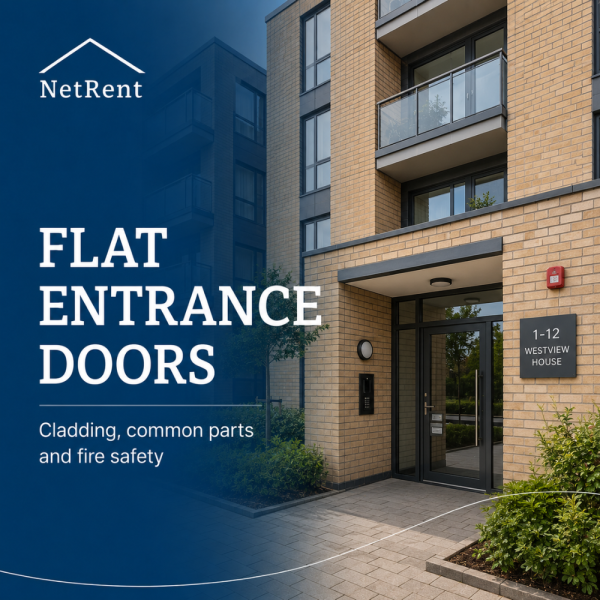
Fire safety in blocks of flats has changed significantly in recent years.
For landlords who own or let flats, the issue is no longer limited to what happens inside the individual flat. The entrance door, the common hallway, the external walls and the management of the wider building can all matter.
This is particularly important for leasehold landlords who may own one flat in a block but still rely on the freeholder, managing agent or management company to manage the building.
The key message is simple: flat landlords should understand how fire safety responsibilities are divided between the individual flat and the wider building.
Why flat entrance doors matter
A flat entrance door is not just a normal front door.
In many blocks, it forms part of the building’s fire safety strategy. It helps to protect the escape route, contain fire and smoke, and give residents more time to leave or remain safely depending on the building’s evacuation strategy.
If a flat entrance door is damaged, altered or replaced incorrectly, it may compromise the safety of the wider building.
This can affect not only the tenant in that flat, but also other residents using the same hallway, staircase or escape route.
The difference between a flat door and an ordinary internal door
A flat entrance door may need to provide fire resistance.
That means it may need:
- a suitable fire door rating;
- a working self-closing device;
- suitable smoke seals;
- intumescent strips;
- appropriate hinges;
- suitable glazing where fitted;
- a properly fitted frame;
- no unauthorised holes or gaps;
- suitable locks and ironmongery;
- a door that closes fully into the frame.
A landlord should not treat a flat entrance door as a decorative item that can be changed without checking the building’s fire safety requirements.
Common problems with flat entrance doors
Problems often arise because doors are changed or altered over time.
Risky changes can include:
- replacing a certified fire door with an ordinary door;
- removing the self-closer;
- fitting unsuitable locks;
- cutting the door for a cat flap;
- drilling holes for extra fittings;
- removing smoke seals;
- fitting unsuitable glazing;
- leaving large gaps around the door;
- wedging the door open;
- failing to repair a damaged frame;
- repainting or modifying labels and evidence of certification.
These may seem like small changes, but they can affect the door’s ability to hold back fire and smoke.
Who is responsible for the flat entrance door?
Responsibility can depend on the lease, the tenancy agreement and the structure of the building.
In some cases, the flat owner may be responsible for the entrance door to the flat.
In other cases, the freeholder or management company may have control over certain aspects of the door, especially where it forms part of the common fire strategy.
Leasehold landlords should check:
- the lease;
- building fire safety documents;
- freeholder requirements;
- management company rules;
- insurer requirements;
- fire risk assessment recommendations;
- any notices or communications about door checks.
A landlord letting a flat should not assume that the door is someone else’s issue without checking.
Tenant alterations
Tenants may sometimes alter doors without realising the risk.
They may fit extra locks, chains, door viewers, letterboxes, cat flaps or other fittings.
Landlords should make clear that tenants must not alter the flat entrance door without permission.
During inspections, landlords or agents should check whether the door has been changed or damaged.
If the door no longer closes properly, has missing seals or has been altered, the issue should be investigated.
Fire door checks
Fire door checks are now a much more visible part of residential building fire safety.
Responsible persons for relevant buildings may need to arrange checks of communal fire doors and, in some buildings, flat entrance doors.
For landlords, the practical point is that access may be needed to check the flat entrance door.
Landlords should cooperate with reasonable fire door inspection requests and should make sure tenants understand why access may be required.
If a tenant refuses access, the landlord should keep clear records of attempts to arrange inspection.
Common parts of blocks of flats
Common parts can include:
- entrance halls;
- corridors;
- staircases;
- landings;
- bin stores;
- meter cupboards;
- plant rooms;
- communal lounges;
- shared laundry rooms;
- internal escape routes;
- external escape stairs.
These areas are usually controlled by the freeholder, management company or managing agent, although the exact position depends on the building.
Common parts are central to fire safety because they may form the escape route for residents.
They should be kept clear, maintained and properly managed.
What landlords should check about common parts
A landlord who lets a flat should know who manages the common parts and whether fire safety is being handled properly.
They should consider:
- whether a fire risk assessment exists;
- who the responsible person is;
- whether escape routes are clear;
- whether fire doors are maintained;
- whether emergency lighting is checked;
- whether fire alarms or detection systems are maintained;
- whether residents receive fire safety information;
- whether bin stores are managed;
- whether combustible materials are removed from communal areas;
- whether the building has a clear evacuation strategy.
The landlord may not control all of these areas, but they should know who does.
Cladding and external walls
After recent reforms, external walls and cladding have become a major fire safety issue.
In blocks of flats, the external wall system may include:
- cladding;
- insulation;
- balconies;
- spandrel panels;
- render systems;
- external fixings;
- cavity barriers;
- attachments to the building.
Concerns about external walls can affect safety, insurance, mortgageability, leasehold value and the ability to sell or refinance.
A landlord letting a flat should understand whether the building has external wall issues and whether the freeholder or managing agent has provided relevant information.
Why leasehold landlords should pay attention
Many landlords who own flats are leaseholders.
They may not control the external walls, roof, corridors or staircases. However, problems with those areas can still affect the letting.
Issues may include:
- tenant safety concerns;
- higher service charges;
- major works demands;
- insurance premium increases;
- mortgage or remortgage difficulties;
- sale delays;
- disputes with managing agents;
- rentability of the flat;
- compliance questions from tenants or agents.
Leasehold landlords should keep building safety correspondence with their property file.
Fire safety information for tenants
Tenants should know what to do in the event of a fire.
In blocks of flats, the evacuation strategy may depend on the design of the building.
Some buildings operate a stay-put strategy. Others may use simultaneous evacuation. The correct approach depends on the building’s fire safety arrangements.
Landlords should make sure tenants receive relevant fire safety information from the freeholder, management company or managing agent where applicable.
They should not invent their own fire strategy without reference to the building’s arrangements.
The danger of blocked escape routes
Common escape routes must be usable.
Problems can arise where residents store items in hallways or staircases, including:
- bicycles;
- prams;
- furniture;
- boxes;
- rubbish;
- shoes;
- plants;
- mobility scooters;
- electrical items.
These can obstruct escape and may also add combustible material to communal areas.
Landlords should remind tenants not to store items in common parts unless permitted by the building management arrangements.
Balconies and fire risk
Balconies can also create fire safety concerns.
Risks may include:
- barbecues;
- discarded cigarettes;
- combustible furniture;
- stored materials;
- gas cylinders;
- artificial grass;
- timber decking;
- external wall materials;
- items placed too close to windows or doors.
Leasehold landlords should check building rules and pass relevant restrictions to tenants.
Balcony misuse can affect the wider building, not just the individual flat.
Internal fire safety inside the flat
The inside of the flat still matters.
Landlords should consider:
- smoke alarms;
- carbon monoxide alarms where required;
- electrical safety;
- gas safety;
- safe heating systems;
- safe supplied appliances;
- furniture and furnishings;
- safe escape from the flat;
- tenant information;
- repair records.
A landlord cannot ignore internal fire safety because the building has a managing agent.
The flat and the wider building both matter.
Communication with managing agents
Leasehold landlords should keep clear communication with the managing agent or freeholder.
They should ask for and retain:
- fire safety notices;
- fire risk assessment summaries where available;
- fire door inspection requests;
- external wall updates;
- evacuation strategy information;
- building safety correspondence;
- insurance updates;
- major works notices;
- instructions for residents;
- restrictions on alterations;
- relevant service charge information.
This can be important for tenants, insurers, lenders and future buyers.
What if the landlord receives a fire safety notice?
A landlord should take any fire safety notice seriously.
This may come from:
- the council;
- the fire and rescue authority;
- the freeholder;
- the managing agent;
- the management company;
- the insurer;
- a contractor;
- a tenant.
The landlord should read the notice carefully, identify what action is required, check deadlines and keep evidence of any response.
Ignoring fire safety correspondence can create avoidable risk.
Insurance and mortgage issues
Fire safety issues can affect insurance and lending.
Insurers may ask about:
- building construction;
- flat entrance doors;
- cladding;
- occupancy;
- HMO use;
- fire alarms;
- fire risk assessments;
- claims history;
- compliance with building requirements.
Lenders may also ask questions where there are external wall or building safety concerns.
Landlords should make sure that the insurance and mortgage position reflects the actual property and its risks.
Why this matters under wider reform
Recent reforms have increased scrutiny of fire safety in residential buildings.
Flat entrance doors, external walls and common parts are now more clearly recognised as part of the building’s fire safety picture.
For landlords, this means the property file should not stop at the tenancy agreement and gas safety certificate.
It should also include relevant building safety and fire safety information, especially for flats in blocks and converted buildings.
Common landlord mistakes
1. Treating the flat entrance door as an ordinary door
It may be part of the building’s fire protection.
2. Allowing unauthorised alterations
Extra locks, cat flaps or other changes may affect fire performance.
3. Ignoring managing agent correspondence
Fire safety notices should be read and stored.
4. Assuming common parts are irrelevant
Shared halls, staircases and corridors can be central to fire safety.
5. Not passing information to tenants
Tenants should understand fire safety instructions and building rules.
6. Ignoring cladding or external wall updates
These can affect safety, insurance, lending and saleability.
7. Keeping poor records
Fire safety records may be important in disputes, insurance queries or enforcement.
Practical checklist for landlords
Landlords should:
- check who is responsible for the flat entrance door;
- review the lease;
- keep fire door inspection records where available;
- check that the door closes properly;
- prevent unauthorised tenant alterations;
- keep fire safety correspondence;
- confirm who manages the common parts;
- understand the building’s fire strategy;
- pass relevant information to tenants;
- keep escape routes clear;
- check balcony restrictions;
- keep external wall and cladding updates;
- review insurance requirements;
- store building safety documents in the property file.
The key takeaway
Fire safety in flats is not limited to the inside of the flat.
Flat entrance doors, common parts, external walls, cladding, escape routes and building management arrangements can all matter.
Leasehold landlords may not control every part of the building, but they should understand who does, what information has been provided and what obligations apply to their own flat.
In the modern private rented sector, fire safety is increasingly documented, inspected and scrutinised.
Landlords should keep clear records, cooperate with building management and make sure tenants understand the fire safety arrangements that apply to the property.
NetRent does not provide legal advice. This article represents our understanding of rental property law at the time of writing.
Telephone: 01352 721300
Email: support@netrent.co.uk