

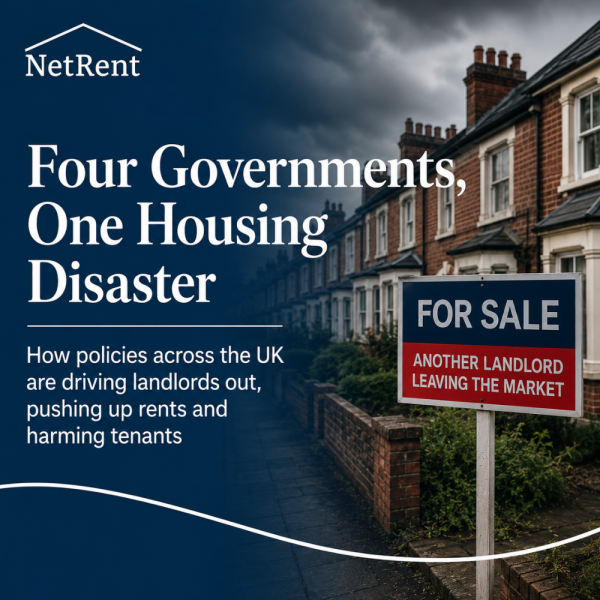
Across England, Scotland, Wales and Northern Ireland, governments claim they want more secure, affordable and better-quality homes for tenants.
Yet all four are pursuing policies that risk achieving precisely the opposite.
Instead of encouraging responsible landlords to remain in the market, improve their properties and invest in additional homes, politicians repeatedly portray the private rented sector as something to be controlled, taxed and punished.
Landlords are routinely described as “rogue”, exploitative or greedy. New regulations are announced as though every property owner is looking for an opportunity to mistreat a tenant. Each additional restriction is presented in isolation as a reasonable protection, with little apparent consideration of the combined financial and operational burden.
The result is a dangerous contradiction.
Britain desperately needs more homes to rent, but its governments are making providing those homes increasingly unattractive, expensive and risky.
Scotland: A Warning the Rest of Britain Should Heed
Reports suggest that thousands of Scottish landlords have already left the sector, with claims that the number has recently been running at approximately ten landlords a day.
That should trigger alarm throughout government.
Scottish landlords have endured emergency rent freezes, eviction restrictions, rent caps, higher taxation and the continuing threat of longer-term rent controls. The Housing (Scotland) Act 2025 has created a framework under which rent-control areas may be introduced where local authorities decide rents are rising too rapidly.
Politicians may describe these controls as tenant protection. Landlords see something very different: the government restricting their income while insurance, mortgages, repairs, tradespeople, management fees and regulatory costs continue to rise.
A landlord cannot tell a roofer, insurer or mortgage lender that their charges must be frozen because the rent has been capped.
When costs increase but income is politically restricted, the inevitable result is reduced investment, deferred improvement work or withdrawal from the market. Selling is not necessarily an ideological protest. It can become the only commercially rational decision.
A government cannot compel private individuals to continue supplying homes at a loss.
England: Regulation Without an Investment Strategy
England’s Renters’ Rights Act represents one of the most significant changes to private renting in decades.
The reforms have abolished Section 21, replaced fixed-term tenancies with a largely periodic system, restricted the frequency of rent increases and introduced stronger enforcement arrangements. Further requirements include a landlord database and membership of a private rented sector ombudsman.
Good tenants deserve secure, safe homes, and criminal landlords should face effective enforcement. That is not in dispute.
The problem is that English housing policy appears to be based on the assumption that landlords can absorb unlimited additional obligations without changing their behaviour.
They cannot.
Possession is likely to become slower, more complicated and more dependent upon an already pressured court system. Compliance costs will increase. Landlords will face greater uncertainty when dealing with serious arrears, antisocial behaviour or circumstances in which they genuinely need to recover their property.
Larger institutional investors may employ legal departments and compliance teams. The typical landlord with one or two properties cannot. Faced with more paperwork, greater legal exposure and diminishing control over a valuable asset, many will simply decide that the potential return no longer justifies the risk.
Recent market evidence does not yet show that the Renters’ Rights Act alone has caused an immediate nationwide exodus. That does not mean the danger is imaginary. The Act sits on top of years of tax changes, lost mortgage-interest relief, higher borrowing costs, licensing schemes, energy-efficiency expenditure and increasingly severe financial penalties.
The effect is cumulative.
Government repeatedly adds another weight to the landlord’s back and then expresses surprise when some finally collapse under the load.
Wales: Regulation Is Becoming a Barrier to Participation
Welsh landlords already operate within one of Britain’s most extensive regulatory structures.
They must navigate Rent Smart Wales, the Renting Homes (Wales) Act, prescribed occupation contracts, detailed property-condition obligations, electrical and safety requirements, longer possession procedures and restrictions on the circumstances in which possession may be sought.
Further rules introduced in 2026 prevent landlords and agents from discriminating against applicants because they have children or receive welfare benefits.
The stated intention is understandable. Blanket exclusions can be unfair. However, legislation cannot erase the commercial questions surrounding affordability, insurance conditions, mortgage requirements, suitability and the risk of rent shortfalls.
A landlord must still assess whether an applicant can sustainably afford the property. Preventing landlords from considering genuine financial risk does not make that risk disappear.
Once again, the danger is that politicians confuse tighter regulation with increased housing provision.
Wales does not merely need stronger rights on paper. It needs actual homes in which people can exercise those rights. A perfectly drafted occupation contract is no help to a family when there are dozens of applicants for every available property.
Northern Ireland: Repeating the Same Mistakes
Northern Ireland is considering further reform of its private rented sector, including stronger tenancy security, tighter possession rules, a housing ombudsman and possible rent controls.
At the same time, the Housing Executive is heavily dependent upon privately owned homes to meet housing need, and the loss of private rented accommodation remains an important contributor to homelessness.
This is the same contradiction found elsewhere in Britain.
Government needs private landlords, but its political language and legislative programme increasingly suggest that it neither trusts nor values them.
Northern Ireland’s electrical-safety requirements now apply widely across the sector, while landlords face the same broader pressures seen elsewhere: rising repair costs, increased insurance premiums, higher interest rates and growing compliance responsibilities.
Adding rent controls and further restrictions without first increasing supply would be reckless. If landlords cannot obtain a return that reflects their costs and risks, properties will be sold, investment will disappear and competition between tenants will intensify.
The “Rogue Landlord” Narrative Has Become Politically Convenient
There are bad landlords. There are also bad employers, builders, accountants, solicitors, public officials and tenants.
Nobody suggests that every member of those groups should be treated as a potential criminal because a minority behaves disgracefully.
Yet the word “landlord” is now frequently preceded by “rogue” in political speeches and government publicity. It has become an easy label through which ministers can demonstrate toughness without addressing the far more difficult problem of inadequate housing supply.
Most private landlords are not large corporations. They are individuals and small businesses. Many own only one or two properties. They invest their own money, carry the borrowing risk, maintain the building and provide a home that the state has neither built nor funded.
Demonising these people has consequences.
Existing landlords become reluctant to expand. Prospective landlords invest elsewhere. Owners nearing retirement sell sooner than planned. The remaining providers become more cautious about whom they accept because every tenancy carries greater risk.
The political attack intended to protect tenants can therefore make finding a home harder for the very people government claims to support.
Fewer Landlords Do Not Mean More Homes for Tenants
Politicians sometimes argue that when a landlord sells, the property does not disappear.
The bricks may remain, but the rental home can disappear.
A property sold to an owner-occupier is no longer available to a tenant. One household may gain a home, but that does nothing for renters who cannot obtain a mortgage, do not have a deposit, need flexibility or are not ready to buy.
The effect can be particularly damaging when shared houses or flats are sold. A property housing several unrelated tenants may become a home for one owner-occupying household. The physical building remains, but the number of people it accommodates can fall substantially.
Shrinking the private rented sector without replacing it with social housing does not solve housing need. It merely forces more people to compete for fewer available homes.
That competition gives landlords a much larger choice of applicants. Those with the highest incomes, strongest references and largest deposits are likely to succeed. Lower-income households, people receiving benefits, young tenants, families and those with imperfect credit histories may struggle most.
Higher Costs Will Ultimately Reach Tenants
Governments often speak as though landlord costs and tenant rents are unrelated.
They are not.
A rental property is expensive to provide. The landlord must meet mortgage interest, insurance, maintenance, safety inspections, licensing charges, agency fees, taxation, periods without rent and the risk of substantial arrears or damage.
When those costs rise, only four outcomes are possible:
The landlord accepts a lower return, reduces expenditure, increases the rent where legally possible or sells the property.
There is no fifth option in which costs rise indefinitely without affecting commercial decisions.
Responsible landlords will continue to maintain safe homes, but they will need rents that make doing so viable. Others will leave. Both outcomes place upward pressure on market rents.
Ironically, policies promoted as a way to make renting cheaper may make it considerably more expensive.
Councils and Taxpayers Will Carry the Cost
When a private tenancy cannot be found, the housing need does not vanish. It moves to the local authority.
Councils must then use temporary accommodation, nightly paid properties, hostels, bed-and-breakfast establishments and hotels. These options are frequently far more expensive than preventing homelessness or helping a household secure an ordinary private tenancy.
England already has record numbers of households in temporary accommodation. Wales has had around 11,000 individuals living in temporary accommodation at a time, including thousands placed in B&Bs and hotels. Scotland continues to face severe temporary-accommodation pressures, while a Northern Ireland Assembly committee has warned about the multimillion-pound cost of emergency provision.
This is public money being spent managing the consequences of housing scarcity.
The absurdity is difficult to ignore. Governments increase the risks and costs faced by ordinary landlords, those landlords withdraw, and councils then pay substantially more to commercial hotel and emergency-accommodation providers.
The taxpayer ultimately funds the failure.
Temporary Accommodation Damages Lives
This is not merely an argument about government budgets or landlord profitability.
The human consequences can be devastating.
Living in a hotel or B&B may mean a family sharing a single room, with no suitable cooking facilities, little privacy and nowhere for children to play or complete homework. Households may be placed far from schools, employment, medical services and family support.
Frequent moves disrupt education and friendships. Overcrowding and uncertainty increase stress. Parents can find it harder to work. Existing physical and mental-health problems may deteriorate.
The UK Government has acknowledged that 132,410 households, including 172,420 children, were living in temporary accommodation in England when its national homelessness plan was published. It also reported that, between 2019 and 2024, 74 children died in circumstances where temporary accommodation may have been a contributing factor.
These are not abstract statistics. They represent families paying the price for a housing system that has failed to provide enough settled homes.
Every responsible landlord driven from the market potentially removes one of those homes.
Regulation Must Be Based on Commercial Reality
None of this means landlords should be above the law.
Properties should be safe. Repairs should be completed. Deposits should be protected. Tenants should be treated professionally. Harassment, illegal eviction and deliberately dangerous housing should be punished.
However, effective regulation must distinguish between criminal behaviour and ordinary landlords making reasonable commercial decisions.
The current direction of policy too often treats profit itself as suspicious. Yet without the prospect of a reasonable return, private investment will not take place.
Politicians cannot demand that landlords improve properties, meet higher standards, accept greater legal risk, pay more tax and charges, restrict their rents and surrender control over possession—while simultaneously expecting them to invest billions of pounds in additional homes.
That is not a housing strategy. It is wishful thinking driven by political dogma rather than commercial reality.
Britain Must Decide Whether It Wants a Private Rented Sector
The private rented sector houses millions of people whom councils and housing associations cannot accommodate.
Government therefore has a choice.
It can recognise responsible landlords as essential housing providers and create a stable environment that encourages long-term investment.
Or it can continue portraying them as social villains, adding costs and restrictions until more conclude that selling is the only sensible option.
What government cannot do is drive landlords away and then pretend to be surprised when rents rise, homelessness increases and councils spend fortunes placing families in hotels.
Tenant protection and landlord confidence are not opposing goals. A successful rental market requires both.
Unless governments across all four nations abandon their hostile, one-sided approach and begin considering the commercial consequences of their decisions, the outcome is predictable:
Fewer landlords. Fewer rental homes. Higher rents. More homelessness. Greater pressure on councils. More families living in unsuitable temporary accommodation.
The people who suffer most will not be politicians.
They will be the tenants these policies were supposedly designed to protect.
Important information: NetRent does not provide legal advice. This article represents our general understanding of the private rented sector and is provided for information and discussion only.