

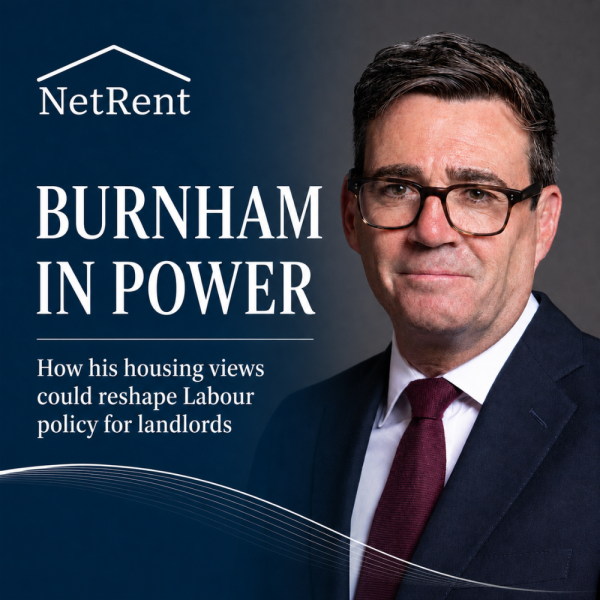
As from today, Andy Burnham becomes Prime Minister after replacing Sir Keir Starmer as leader of the Labour Party. For landlords, letting agents and the wider private rented sector, the immediate question is not simply political. It is practical: will a Burnham government continue the housing reforms already set in motion under Starmer, or will it go further?
The answer is likely to be both.
Under Sir Keir Starmer, Labour had already committed itself to major reform of the private rented sector. The Renters’ Rights Act brought forward the abolition of Section 21 “no fault” evictions, a new Private Rented Sector Landlord Ombudsman, stronger rent challenge mechanisms, restrictions on discrimination against tenants with children or receiving benefits, and the extension of Awaab’s Law principles into the private rented sector. Labour’s wider manifesto also promised 1.5 million new homes, planning reform, more social rented homes and stronger protections for renters.
Burnham does not arrive as a blank sheet. As Mayor of Greater Manchester, he has spent the last five years developing a housing agenda that gives a clear indication of where he may want national policy to move next. His approach has been built around four themes: stronger tenant rights, higher property standards, more council and social housing, and greater local enforcement powers.
At the centre of Burnham’s Greater Manchester strategy was the Good Landlord Charter. This was presented as a voluntary scheme designed to raise standards across both private and social rented homes. The Charter describes itself as a way to support landlords to aim above the minimum legal standard, with criteria covering affordability, inclusivity, privacy, repairs, management, safety and decency.
Importantly, Burnham has repeatedly tried to frame the Charter as a “twin-track” approach: recognising good landlords while taking tougher action against those who provide poor housing. That distinction matters. It suggests that Burnham understands there are responsible landlords who should not be grouped together with genuinely poor operators. However, it also shows that he sees government intervention, accreditation and enforcement as central to improving the rental market.
His 2023 Housing speech in Manchester gives the clearest indication of his thinking. Burnham argued that housing should be treated as a health issue and said the UK should adopt a “Housing First” philosophy. He described the death of Awaab Ishak as a “moral outrage” and said the wider housing crisis was an “indictment of national housing policy”. He also said his ambition was for Greater Manchester to deliver “a healthy home for all by 2038”.
For landlords, the most important part of that speech was his focus on the private rented sector. Burnham said that in Greater Manchester “15% of homes had a Category One hazard” and that more than “26% are non-decent” in the private rented sector. He argued that too much public money was ending up with landlords whose properties were not being maintained to acceptable standards.
He then set out a much more interventionist model. Tenants in poor homes would be able to request a “GM Property Check”. Councils and multi-agency teams would inspect properties. Landlords could be issued with a Property Improvement Plan. If they failed to engage, Burnham said authorities should use stronger enforcement powers and, ultimately, seek ways to take properties out of the hands of “unscrupulous landlords” and into the hands of those who would manage them properly.
That is the point landlords need to watch closely. Starmer’s reforms changed the legal framework for renting. Burnham’s Manchester model points towards something more operational: local inspection, landlord accreditation, public-sector oversight, targeted enforcement and potentially easier routes for councils to intervene directly in privately owned rental homes.
Burnham has also placed heavy emphasis on social and council housing. In 2024 he pledged 10,000 new council homes in Greater Manchester by 2028 and called for powers to suspend Right to Buy on new council homes and in areas of greatest housing need. His argument was that social housing stock was being lost into the private rented sector and that councils needed stronger powers to rebuild supply.
That differs in emphasis from the Starmer programme. Starmer’s Labour promised more homes, more planning reform, first-time buyer support and a major boost to affordable and social housing. Burnham appears more focused on council-led delivery, local control and social rent as a central answer to the housing crisis. That may appeal to tenants and local authorities facing homelessness pressures, but it also raises questions about where private landlords fit into the long-term strategy.
There is a positive interpretation. Burnham has spoken to landlord organisations and has indicated that he does not want responsible landlords to leave the market. The NRLA reported that he told its 2024 conference he wanted to work with landlords to ensure regulation was fair and effective. That is important, because any government that drives good landlords out of the sector will reduce supply, increase pressure on rents and increase costs for councils already struggling with temporary accommodation.
But there is also a clear risk. If Burnham’s national housing policy follows the Greater Manchester model too aggressively, landlords could face another layer of expectations on top of the Renters’ Rights Act, selective licensing, HMO licensing, energy efficiency demands, tax pressures, mortgage costs and increasingly complex compliance rules.
The danger is that policy makers continue to talk about “rogue landlords” as if they represent the entire sector. Bad landlords do exist, and they damage tenants, communities and the reputation of responsible property owners. They should be dealt with robustly. But most landlords are not large corporate operators with unlimited resources. Many are small businesses, pension investors or portfolio landlords already facing rising costs and reduced confidence.
If a Burnham government recognises that distinction, there may be room for a more balanced settlement: higher standards, but with practical support; stronger enforcement, but aimed at the worst properties; tenant protection, but with a functioning court system and clear possession rights; investment in council housing, but not at the expense of pushing private landlords out of the market.
If it fails to recognise that distinction, the private rented sector could shrink further. That would not help tenants. Fewer rental homes means less choice, higher competition, higher rents and more pressure on councils to house families in hotels, B&Bs and temporary accommodation.
The key issue is supply. Regulation can improve standards, but regulation cannot house people if landlords sell and new rental investment dries up. Council housebuilding may help over time, but it cannot replace the private rented sector overnight. The UK relies on private landlords to provide millions of homes. Any serious housing strategy has to acknowledge that reality.
Burnham’s record suggests that landlords should expect a government that is more localist, more interventionist and more willing to use enforcement as a policy tool. It may also be a government more serious about social housing and council-led delivery than the Starmer administration. For tenants in poor housing, that may be welcome. For good landlords, the test will be whether they are treated as partners in solving the housing crisis or as part of the problem.
As from today, the private rented sector is dealing with a new Prime Minister whose housing views are already well documented. The message from Greater Manchester is clear: higher standards, more tenant power, stronger local enforcement and a bigger role for councils.
The question now is whether that becomes national Labour policy — and whether the new Prime Minister understands that driving out good landlords would make Britain’s housing crisis worse, not better.
NetRent does not provide legal advice. This article represents our general understanding of current housing policy and the private rented sector and is provided for information only.