

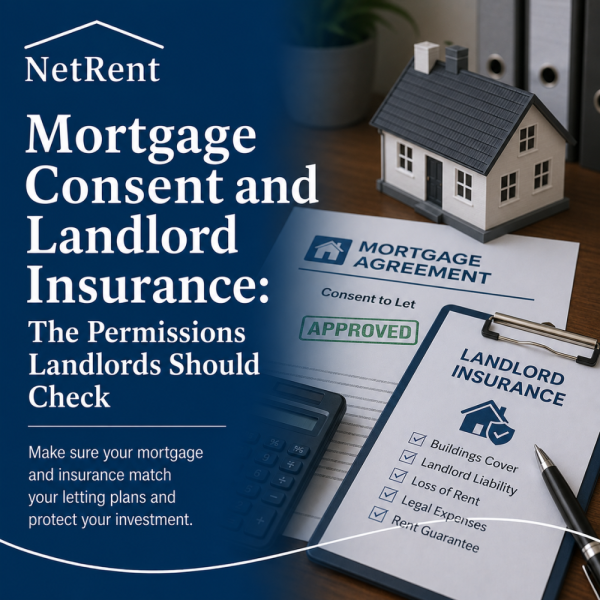
Letting a property is not just about finding a tenant and signing a tenancy agreement.
Before a landlord lets a property, they should check whether they actually have permission to do so.
Two areas are especially important: the mortgage and the insurance.
A landlord may own the property, but that does not mean they can let it in any way they choose without checking lender conditions, insurance terms, lease restrictions and the type of occupation proposed.
The key message is simple: before letting a property, landlords should make sure the mortgage and insurance arrangements match the way the property is being used.
Why permission matters
Letting a property can change the risk profile of that property.
A home occupied by the owner is not the same risk as a property occupied by tenants.
A single-family let is not the same as an HMO.
A standard long-term tenancy is not the same as serviced accommodation or short-term letting.
A property let to students, company occupiers or multiple unrelated sharers may also raise different lender and insurance questions.
If landlords do not check permissions, they may face:
- mortgage breach issues;
- insurance problems;
- rejected claims;
- lender enforcement action;
- higher costs;
- difficulty remortgaging;
- sale delays;
- leasehold disputes;
- problems after a serious incident;
- problems if the tenant arrangement changes.
Permission is not an admin detail. It can affect the whole investment.
Residential mortgage or buy-to-let mortgage?
The first question is what type of mortgage is secured against the property.
A residential mortgage is usually designed for a property occupied by the owner as their home.
A buy-to-let mortgage is designed for a property that is let to tenants.
If a landlord has a residential mortgage and wants to rent the property out, they should not assume that is allowed.
They may need the lender’s written consent to let or may need to switch to a buy-to-let mortgage.
Letting a property without the correct mortgage permission may put the landlord in breach of mortgage conditions.
Consent to let
Consent to let is permission from a residential mortgage lender to let the property for a period of time.
This may be relevant where a homeowner moves out temporarily but does not immediately move the property onto a buy-to-let mortgage.
Examples may include:
- moving for work;
- moving in with a partner;
- relocating temporarily;
- moving abroad for a period;
- needing to let rather than sell;
- delays in selling;
- temporary family circumstances.
Consent to let is usually not the same as having a buy-to-let mortgage.
It may be time-limited, subject to conditions and reviewed by the lender.
Get consent before letting
Landlords should apply for consent before the tenancy begins.
They should not let first and ask later.
The lender may want information such as:
- why the property is being let;
- how long the letting is expected to last;
- proposed tenancy type;
- expected rent;
- whether a letting agent will be used;
- whether the borrower will live elsewhere;
- whether the property will be let furnished;
- whether the property will be let to a family, sharers or company;
- whether the property will be used as an HMO or short let.
The landlord should keep the lender’s consent letter or written approval in the property file.
Consent may have conditions
Mortgage consent may come with conditions.
These may include:
- a time limit;
- a fee;
- an interest rate change;
- restrictions on tenancy length;
- a requirement for an assured tenancy;
- restrictions on HMOs;
- restrictions on short lets;
- restrictions on company lets;
- restrictions on letting to family members;
- requirements for buildings insurance;
- notification if circumstances change.
Landlords should read the consent carefully.
Permission to let does not always mean permission for every type of letting.
Buy-to-let mortgage conditions
Even where the property is already on a buy-to-let mortgage, conditions still matter.
Buy-to-let lenders may restrict or require approval for:
- HMOs;
- multi-unit blocks;
- student lets;
- company lets;
- holiday lets;
- serviced accommodation;
- short-term lets;
- local authority lets;
- supported living;
- rent-to-rent arrangements;
- tenants who are family members;
- property held in a limited company;
- major alterations;
- leasehold restrictions;
- minimum tenancy terms;
- maximum tenancy terms.
A landlord should check the mortgage offer and special conditions, not just the headline product type.
Remortgaging
Permissions also matter when remortgaging.
A lender or broker may ask how the property is used.
If the property has been let in a way that breaches mortgage conditions, that may complicate the remortgage.
Landlords should be honest about:
- tenant type;
- tenancy structure;
- rent;
- leasehold status;
- licensing;
- HMO use;
- short-let use;
- company lets;
- property condition;
- arrears;
- voids;
- insurance position.
Trying to present the property as a standard let when it is not can create later problems.
Landlord insurance
Insurance is the second major permission issue.
A standard home insurance policy is usually intended for owner occupation.
Once a property is let, the landlord normally needs suitable landlord insurance.
The policy should match the property use.
This may include cover for:
- buildings;
- landlord contents;
- property owner’s liability;
- loss of rent;
- alternative accommodation;
- malicious damage;
- accidental damage;
- legal expenses;
- rent guarantee;
- unoccupied periods;
- HMO use;
- student lets;
- short lets;
- commercial or mixed use where relevant.
Landlord insurance should not be treated as a generic product.
Buildings insurance
Buildings insurance may be arranged by the landlord, lender, freeholder or management company depending on the property.
For houses, the landlord usually arranges buildings insurance directly.
For leasehold flats, the freeholder or management company often arranges the block buildings insurance, with the leaseholder paying through the service charge.
However, leasehold landlords should not assume the block policy covers everything they need.
They may still need:
- landlord contents cover;
- landlord liability cover;
- loss of rent cover;
- legal expenses cover;
- rent guarantee cover;
- cover for fixtures and fittings not fully covered by the block policy;
- cover for the specific letting arrangement.
Tell the insurer the property is let
Landlords should tell the insurer the property is being let.
They should also give accurate information about:
- tenant type;
- tenancy type;
- whether the property is furnished;
- number of occupiers;
- HMO status;
- student occupation;
- benefit-supported tenants;
- company lets;
- short lets;
- unoccupied periods;
- locks and security;
- claims history;
- property condition;
- building works;
- subsidence, flood or other risks.
Insurance is based on disclosure.
If the insurer is not told about material facts, a claim may be at risk.
Tenant type and occupation
Insurers and lenders may treat different tenant types differently.
Questions may arise around:
- families;
- professionals;
- students;
- sharers;
- HMOs;
- company lets;
- local authority lets;
- supported living;
- short-term guests;
- holiday lets;
- asylum or temporary accommodation contracts;
- relatives;
- lodgers.
Landlords should avoid assuming that “tenant” means the same thing in every policy or mortgage condition.
The detail matters.
HMOs
HMOs need particular care.
A property let to multiple unrelated occupiers may require HMO licensing and may also need specialist insurance and mortgage approval.
A standard buy-to-let mortgage or landlord insurance policy may not be enough.
Landlords should check:
- whether the property is an HMO;
- whether a licence is required;
- whether the mortgage allows HMO use;
- whether the insurer has been told;
- whether fire safety requirements are met;
- whether room lets are insured;
- whether communal areas are covered;
- whether the policy has inspection conditions.
HMO use should never be assumed to be covered automatically.
Short-term lets and serviced accommodation
Short-term letting is another high-risk area.
A landlord may move from a standard tenancy to short stays because the income appears higher.
But short-term letting can affect:
- mortgage consent;
- lease restrictions;
- planning rules;
- insurance cover;
- security;
- nuisance complaints;
- fire safety;
- wear and tear;
- tax treatment;
- local licensing where relevant.
A landlord with ordinary buy-to-let finance and standard landlord insurance should not assume short lets are permitted.
Company lets
Company lets can also change the risk.
The landlord may contract with a company, but the people occupying the property may change.
This can raise questions about:
- who is actually living there;
- whether the arrangement is a genuine company let;
- whether the property becomes an HMO;
- whether the company will sublet;
- whether the mortgage allows company occupation;
- whether the insurer covers the use;
- whether the lease permits it;
- whether the property is being used for serviced accommodation.
Landlords should understand the full arrangement before agreeing.
Rent-to-rent
Rent-to-rent arrangements can create serious permission issues.
A landlord may grant a tenancy or agreement to a company or individual who then rents the property on to others.
Before agreeing, landlords should check:
- mortgage permission;
- insurance cover;
- lease restrictions;
- licensing;
- HMO risk;
- planning issues;
- liability for damage;
- who manages repairs;
- who occupies the property;
- whether the arrangement is permitted by the tenancy agreement;
- whether the insurer has accepted the structure.
A landlord may lose control of how the property is actually used.
Leasehold restrictions
Leasehold landlords must also check the lease.
Even if the mortgage lender and insurer are satisfied, the lease may restrict:
- subletting;
- short lets;
- company lets;
- HMOs;
- pets;
- alterations;
- flooring;
- parking;
- balcony use;
- business use;
- common parts;
- registration of tenancies;
- consent requirements.
The lease, mortgage and insurance all need to align.
It is not enough for one of them to permit the arrangement if another one prohibits it.
Licensing and consent
Property licensing is separate from mortgage and insurance consent.
A landlord may need:
- HMO licence;
- additional licensing;
- selective licensing;
- planning permission;
- building regulation approval;
- lease consent;
- lender consent;
- insurer acceptance.
These are different issues.
Having one permission does not mean the others are covered.
A landlord with a licence may still breach mortgage conditions. A landlord with mortgage consent may still need a licence. A landlord with insurance may still breach the lease.
What if the tenant arrangement changes?
Permissions should be reviewed when the tenant arrangement changes.
This may include:
- moving from one household to sharers;
- letting by the room;
- taking students;
- accepting a company let;
- allowing short stays;
- adding occupiers;
- allowing subletting;
- leaving the property empty;
- carrying out major works;
- allowing a tenant to run a business;
- accepting supported living arrangements.
A change in use can change the mortgage and insurance position.
Empty properties
Unoccupied periods are also important.
Insurance policies often include conditions for empty properties.
These may relate to:
- maximum unoccupied periods;
- inspection frequency;
- heating;
- draining down water systems;
- security;
- post collection;
- works being carried out;
- notification to the insurer;
- reduced cover after a certain number of days.
A landlord should check the policy if the property is empty between tenancies or during refurbishment.
Mortgage lenders may also be interested if the property is empty for an extended period.
Repairs and building works
Major works can affect both mortgage and insurance.
Landlords should check before:
- structural works;
- extensions;
- conversions;
- loft works;
- removing walls;
- changing use;
- creating an HMO;
- adding rooms;
- major refurbishment;
- works requiring planning or building regulations;
- works affecting leasehold common parts.
Insurers may require notification if the property is undergoing significant works or is unoccupied during works.
Claims risk
The real danger often appears when there is a claim.
For example:
- a fire occurs and the insurer discovers the property was an undisclosed HMO;
- a tenant causes damage and the policy excludes that tenant type;
- a leak occurs during an unoccupied period and inspection conditions were not met;
- a short-let guest causes damage but short lets were excluded;
- a company let is treated differently from a standard tenancy;
- a flat entrance door was altered without consent;
- the mortgage lender finds the property was let without approval.
Insurance problems usually become urgent after something has gone wrong.
That is the worst time to discover that the policy did not match the letting.
What landlords should keep on file
Landlords should keep a permissions file for each property.
This may include:
- mortgage offer;
- mortgage conditions;
- lender consent to let;
- buy-to-let mortgage documents;
- insurance policy schedule;
- policy wording;
- insurer correspondence;
- lease and lease consents;
- HMO or selective licences;
- planning permissions where relevant;
- tenancy agreement;
- agent terms;
- evidence of tenant type;
- inspection records;
- unoccupied property records;
- correspondence about changes in use.
Good records help landlords prove what was disclosed and agreed.
Questions to ask before letting
Before letting a property, landlords should ask:
- is the mortgage residential or buy-to-let?
- do I need consent to let?
- is consent written and current?
- does the mortgage allow this tenant type?
- does the mortgage allow this tenancy structure?
- does the insurer know the property is let?
- does the policy cover the actual occupation?
- does the lease allow subletting?
- is any freeholder consent needed?
- is licensing required?
- are short lets, HMOs or company lets excluded?
- what happens if the property is empty?
- are there inspection conditions?
- are all documents stored safely?
These questions should be asked before the tenant moves in.
Agent involvement
Letting agents can help, but landlords should not assume the agent has checked everything.
The landlord remains responsible for mortgage, insurance and lease arrangements.
Landlords should tell agents about any restrictions and ask the agent to flag proposed tenant arrangements that might affect permission.
Agents should not be instructed to market the property in a way that conflicts with the mortgage, insurance or lease.
Portfolio landlords
Portfolio landlords need an organised approach.
Different properties may have different:
- lenders;
- mortgage conditions;
- insurers;
- policy wording;
- lease restrictions;
- licences;
- tenant types;
- management arrangements.
A permission that applies to one property may not apply to another.
Portfolio landlords should keep property-by-property records rather than relying on general assumptions.
Common landlord mistakes
1. Letting on a residential mortgage without consent
This can breach lender conditions.
2. Assuming buy-to-let means every type of letting is allowed
HMOs, short lets and company lets may need separate approval.
3. Using standard home insurance
Owner-occupier insurance is unlikely to be suitable for a rental property.
4. Not telling the insurer about tenant type
The policy should reflect the actual use.
5. Ignoring unoccupied conditions
Empty periods can reduce or restrict cover.
6. Forgetting leasehold consent
A lease may restrict letting even where the lender and insurer agree.
7. Keeping no written evidence
Written permissions and policy documents should be stored.
Practical checklist for landlords
Landlords should:
- check the mortgage type;
- obtain written consent to let where needed;
- review buy-to-let mortgage conditions;
- check restrictions on HMOs, short lets and company lets;
- inform the insurer that the property is let;
- check the insurance matches the tenant type;
- review unoccupied property conditions;
- check leasehold restrictions;
- obtain freeholder consent where required;
- confirm licensing requirements;
- keep written permissions;
- review arrangements when occupation changes;
- store mortgage, insurance and lease documents together.
The key takeaway
Landlords should not treat mortgage consent and insurance as background paperwork.
They are central to whether the property can be let safely and properly.
A landlord who lets without checking permission may create mortgage problems, insurance gaps, lease breaches and serious financial risk if something goes wrong.
The safest approach is to check before letting, disclose accurately, keep written evidence and review permissions whenever the property use changes.
In rental property, the tenancy agreement is only part of the picture. The mortgage, insurance and lease may matter just as much.
NetRent does not provide legal advice, mortgage advice, insurance advice or tax advice. This article represents our understanding of rental property mortgage, insurance and compliance issues at the time of writing. Landlords should take professional advice where required.
Telephone: 01352 721300
Email: support@netrent.co.uk