

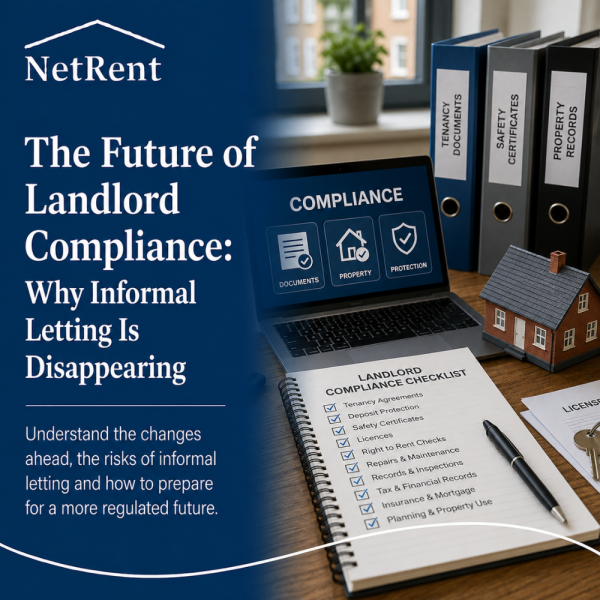
For many years, some landlords treated letting as a relatively informal arrangement.
A property was advertised, a tenant moved in, rent was collected and problems were dealt with when they arose.
That approach is becoming much harder to sustain.
The private rented sector is moving towards a more formal, more regulated and more transparent model. Landlords are expected to keep better records, understand more rules, respond faster to problems and prove compliance when asked.
The key message is simple: informal letting is disappearing, and landlords need to treat rental property as a properly managed business activity.
The direction of travel
Landlord compliance is no longer limited to a few basic documents.
Modern landlords may need to think about:
- tenancy law;
- deposit protection;
- rent increases;
- possession rules;
- licensing;
- safety checks;
- repairs;
- damp and mould;
- data protection;
- right to rent;
- consumer protection;
- advertising standards;
- tax records;
- insurance conditions;
- mortgage consent;
- planning;
- leasehold restrictions;
- fire safety;
- waste management;
- overcrowding;
- anti-social behaviour;
- vulnerable occupiers;
- modern slavery red flags.
The list is growing because rental property sits at the centre of housing, safety, taxation, consumer protection and local authority enforcement.
The Renters’ Rights Act has changed expectations
The Renters’ Rights Act has moved the sector further away from informal arrangements.
Landlords now need to understand new rules around possession, rent increases, discrimination, tenancy structure, enforcement and future systems such as the private rented sector database and landlord ombudsman.
The practical result is that landlords will need clearer records.
They may need to evidence:
- why a possession ground applies;
- whether notices were valid;
- how rent increases were handled;
- how repairs were managed;
- whether complaints were addressed;
- whether tenancy information was provided;
- whether the property was lawfully let;
- whether records match the landlord’s position.
A landlord who has relied on memory, informal messages or incomplete paperwork may find this increasingly difficult.
Digital records are becoming normal
Landlords are also facing a more digital compliance environment.
Making Tax Digital is a clear example. Landlords within scope are being moved towards digital record keeping and regular reporting.
This is not just a tax change. It reflects a wider shift.
Landlords are increasingly expected to have organised records for:
- rent;
- expenses;
- repairs;
- invoices;
- safety checks;
- inspections;
- deposits;
- tenant communications;
- licences;
- mortgage and insurance documents;
- planning records;
- tax information;
- agent statements;
- tenancy documents.
The landlord of the future will need records that are accurate, accessible and up to date.
Councils are becoming more data-led
Local authorities already use information from many sources.
These may include:
- HMO licensing records;
- selective licensing schemes;
- council tax data;
- complaints;
- planning records;
- environmental health inspections;
- waste reports;
- anti-social behaviour reports;
- electoral roll information;
- benefit data;
- neighbour complaints;
- tenancy relations enquiries;
- fire service referrals.
As more systems become digital, it becomes easier for councils to identify patterns.
A property that is advertised as an HMO, used as a short-term let, generating waste complaints, showing signs of overcrowding or missing from licensing records may become more visible.
Landlords should assume that poor compliance will become easier to detect.
The PRS Database will increase visibility
The private rented sector database is expected to make landlord and property information more visible.
Its full practical operation will depend on implementation, but the direction is clear.
A central database can make it easier to connect landlords, properties, enforcement records and compliance expectations.
Landlords should prepare for a future where it is harder to operate unnoticed.
This does not need to worry responsible landlords. But it does mean paperwork, property standards and compliance history will matter.
The landlord ombudsman will change complaint handling
The future landlord ombudsman is also important.
At present, many private landlords handle tenant complaints informally. Some respond well. Others delay, ignore or fail to record what has happened.
An ombudsman-style system is likely to make complaint handling more structured.
Landlords should expect greater emphasis on:
- acknowledging complaints;
- keeping records;
- responding within reasonable timescales;
- explaining decisions;
- documenting repairs;
- retaining contractor evidence;
- showing communication history;
- resolving issues before they escalate.
Good complaint handling will become part of good landlord management.
Licensing is expanding locally
Licensing is another area where informal letting is under pressure.
Many landlords understand mandatory HMO licensing, but fewer realise that additional licensing and selective licensing can vary significantly by local authority area.
A property may need a licence because of:
- the number of occupiers;
- household structure;
- local additional licensing;
- selective licensing designation;
- use as an HMO;
- management arrangements;
- local enforcement priorities.
Licensing schemes often bring conditions about safety, management, waste, anti-social behaviour and property standards.
Landlords should check local licensing requirements before and during ownership.
Safety standards are becoming more detailed
Safety compliance is no longer only about having a gas certificate.
Landlords may need to consider:
- gas safety;
- electrical safety;
- smoke alarms;
- carbon monoxide alarms;
- fire doors;
- escape routes;
- furniture and furnishings;
- legionella risk;
- damp and mould;
- hazards under the housing health and safety system;
- building safety obligations;
- flat entrance doors;
- common parts;
- overcrowding;
- room use;
- blocked escape routes.
Safety records need to be complete, current and property-specific.
A landlord cannot safely assume that a property is compliant because “it has always been let that way.”
Repairs are becoming more evidence-driven
Repair complaints can escalate quickly.
A tenant may complain to the council, raise disrepair, challenge rent, involve an ombudsman, contact a solicitor or share evidence online.
Landlords should keep clear records of:
- when a repair was reported;
- what was reported;
- how the landlord responded;
- contractor appointments;
- access issues;
- photographs;
- invoices;
- completion dates;
- follow-up messages;
- reasons for delay;
- tenant communications.
Where damp, mould, leaks, electrical concerns or heating failures are involved, records can be especially important.
The landlord who acts quickly and keeps evidence is in a much stronger position.
Informal messages are not enough
Many landlords rely on text messages, WhatsApp threads or casual calls.
These can be useful, but they are not always enough.
Problems arise when:
- messages are deleted;
- a phone is lost;
- the landlord cannot find the right conversation;
- several people manage the property;
- an agent changes;
- a tenant disputes what was agreed;
- the council asks for records;
- the landlord needs proof for deposit, insurance or court purposes.
Landlords should move important matters into proper written records and store them safely.
Tenant selection is changing
Tenant selection is also becoming more regulated and more sensitive.
Landlords should avoid discriminatory wording, blanket exclusions and unfair assumptions.
They should be able to explain decisions based on clear, relevant and consistent criteria.
This matters for:
- affordability;
- references;
- guarantors;
- right to rent;
- pets;
- children;
- benefits;
- disability;
- vulnerability;
- household size;
- suitability of the property.
A landlord should not rely on vague instinct alone.
Consistent records help show that decisions were fair and evidence-based.
Advertising is under more scrutiny
Rental adverts need to be accurate.
Landlords and agents should avoid misleading information about:
- rent;
- deposits;
- holding deposits;
- fees;
- property size;
- bills;
- licences;
- parking;
- council tax;
- availability;
- restrictions;
- tenancy terms;
- suitability;
- furniture;
- utilities;
- broadband;
- pets;
- occupation levels.
An advert is no longer just a marketing tool. It can become evidence of what was promised.
Property use is more complex
A property may no longer be used only as a simple family home or standard buy-to-let.
Modern rental models include:
- HMOs;
- company lets;
- rent-to-rent;
- short-term lets;
- serviced accommodation;
- supported accommodation;
- temporary accommodation;
- worker accommodation;
- student lets;
- mixed residential and business use.
Each model can create different planning, licensing, mortgage, insurance, fire safety and tax issues.
Landlords should understand the use before allowing it.
Mortgage and insurance checks are essential
Compliance is not only about public law.
A landlord may also be bound by mortgage and insurance conditions.
Problems can arise where a property becomes:
- an HMO;
- a short-term let;
- serviced accommodation;
- company accommodation;
- rent-to-rent;
- overcrowded;
- vacant for long periods;
- occupied by an excluded tenant type;
- used for business activity;
- subject to structural works.
If the use changes, the lender and insurer position should be checked.
A landlord who ignores this may discover the problem only when a claim or remortgage arises.
Leasehold landlords face extra rules
Leasehold landlords have another layer of compliance.
A lease may restrict:
- subletting;
- short-term lets;
- HMOs;
- business use;
- alterations;
- pets;
- noise;
- flooring;
- communal areas;
- key safes;
- signage;
- storage;
- waste;
- nuisance.
A landlord may comply with tenancy law but still breach the lease.
The future of landlord compliance will require landlords to look beyond the tenancy agreement.
Tax compliance is becoming harder to ignore
Rental income has always needed proper tax treatment.
What is changing is the level of digital record keeping expected from many landlords.
Landlords should keep organised records for:
- rent received;
- allowable expenses;
- repairs;
- finance costs;
- insurance;
- agent fees;
- service charges;
- ground rent;
- licences;
- legal fees;
- professional fees;
- mileage;
- capital works;
- property improvements;
- sale and purchase records.
Tax is becoming more connected to digital administration.
Landlords who keep poor records may struggle.
Informal cash arrangements are high risk
Cash rent, unclear third-party payments and undocumented arrangements are becoming increasingly risky.
They can raise questions around:
- tax;
- money laundering;
- affordability;
- tenant identity;
- illegal subletting;
- exploitation;
- modern slavery;
- rent arrears;
- deposit disputes;
- possession evidence.
Landlords should understand who is paying rent, why they are paying and whether the arrangement matches the tenancy.
Agents will need to evidence more
Landlords using agents should not assume that “the agent handles everything” is enough.
Landlords should know:
- what checks the agent completed;
- where documents are stored;
- whether licences are in place;
- whether safety certificates are current;
- whether inspections are happening;
- how repairs are logged;
- how complaints are handled;
- whether rent and tax records are complete;
- whether the property use is permitted;
- whether insurance and mortgage conditions match the tenancy.
A good agent can be extremely valuable, but the landlord should still understand the overall compliance position.
The landlord file
Every landlord should think in terms of a complete landlord file.
This may include:
- title and ownership records;
- mortgage consent;
- insurance documents;
- lease and freeholder consent where relevant;
- planning records;
- building regulations records;
- tenancy agreement;
- prescribed information;
- deposit documents;
- inventory;
- right to rent records;
- safety certificates;
- alarm records;
- fire safety records;
- EPC;
- licences;
- inspection reports;
- repair records;
- contractor invoices;
- rent schedule;
- tax records;
- communications;
- complaint records;
- end-of-tenancy evidence.
A well-managed landlord file is one of the clearest signs of a professional approach.
Small landlords are not exempt from professionalism
Many landlords own only one or two properties.
That does not mean compliance can be informal.
Small landlords still need to understand their obligations.
The same tenant safety issues, deposit rules, repair duties, licensing risks, tax responsibilities and insurance conditions may apply.
The future of the sector is not only about large portfolio landlords. It is about raising expectations across the whole private rented sector.
Why this matters commercially
Compliance is not just about avoiding penalties.
It can affect:
- mortgage applications;
- insurance claims;
- property value;
- saleability;
- tenant retention;
- rent arrears;
- court claims;
- deposit disputes;
- council relationships;
- agent relationships;
- reputation;
- future investment decisions.
A compliant, well-documented property is easier to manage and easier to defend if challenged.
Common landlord mistakes
1. Treating letting as informal income
Rental property should be managed as a serious business activity.
2. Keeping poor records
If the landlord cannot prove compliance, the position becomes weaker.
3. Ignoring local rules
Licensing, planning and enforcement priorities vary by area.
4. Assuming old habits still work
The sector is moving towards more transparency and stronger enforcement.
5. Relying entirely on agents
Agents help, but landlords should still understand the compliance position.
6. Forgetting mortgage and insurance conditions
A legally valid tenancy may still breach lender or insurer requirements.
7. Waiting for a problem before organising paperwork
Records should be created as part of normal management, not after a dispute begins.
Practical checklist for landlords
Landlords should:
- review every property in their portfolio;
- identify the current use of each property;
- check licensing requirements;
- check planning restrictions;
- confirm mortgage consent;
- confirm insurance cover;
- review leasehold restrictions;
- organise safety certificates;
- keep inspection records;
- document repairs;
- record tenant complaints;
- store tenancy documents;
- keep rent and expense records;
- prepare for digital tax reporting where relevant;
- check local authority rules;
- understand Renters’ Rights Act changes;
- prepare for future database and ombudsman requirements;
- avoid informal cash arrangements;
- keep a clear landlord file.
The key takeaway
The future of landlord compliance is clear.
Letting property is becoming more digital, more regulated, more visible and more evidence-based.
The landlords who adapt will be better placed to manage risk, protect their investment and operate confidently.
The landlords who continue to rely on informal arrangements, missing paperwork and “we have always done it this way” are likely to face growing difficulty.
In the modern private rented sector, successful landlords will not only own property. They will manage records, risks, responsibilities and relationships properly.
NetRent does not provide legal advice, tax advice, planning advice, building control advice, mortgage advice, insurance advice or financial advice. This article represents our understanding of rental property compliance issues at the time of writing. Landlords should take professional advice where required.
Telephone: 01352 721300
Email: support@netrent.co.uk