

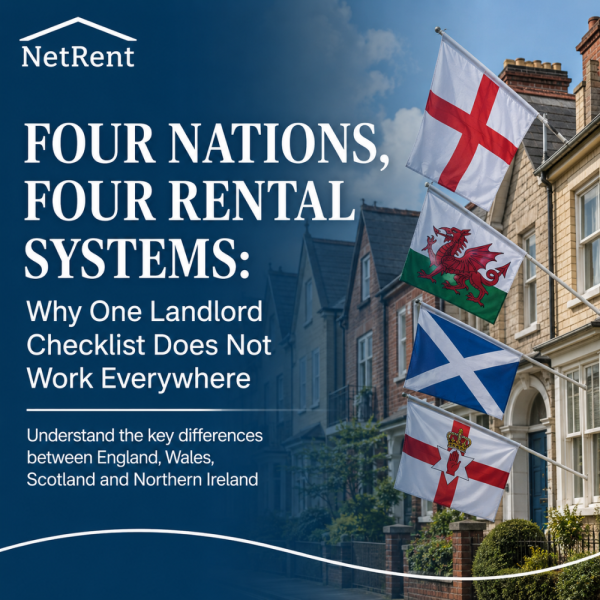
Landlords operating across the UK need to be careful when reading about changes to rental law.
There is no single legal system governing the whole UK Private Rented Sector. England, Wales, Scotland and Northern Ireland each have their own rules, terminology and procedures.
A landlord who owns properties in more than one nation therefore cannot safely use one tenancy agreement, one possession checklist or one set of compliance procedures for every property.
England: a new assured periodic tenancy system
England has recently undergone major reform.
Since 1 May 2026, most existing assured shorthold tenancies have become assured periodic tenancies, while new assured tenancies are generally created as periodic tenancies rather than traditional fixed-term ASTs. Section 21 possession has also ended for tenancies covered by the new regime.
Landlords in England also need to understand new rules covering areas including rent increases, rent in advance, rental bidding, requests to keep pets and discrimination against applicants because they have children or receive benefits.
For many landlords, this means procedures that were familiar only a year ago have now changed significantly.
But those English reforms should not simply be copied into procedures for properties elsewhere in the UK.
Wales: occupation contracts, not ASTs
Wales operates under the Renting Homes (Wales) Act 2016 framework.
Instead of referring primarily to tenants and tenancy agreements, Welsh law uses terms including contract-holder, occupation contract and written statement.
Most private landlords use standard occupation contracts, and landlords have specific responsibilities concerning the written statement setting out the terms of the contract.
Wales also has its own rules covering possession, property fitness and landlord registration and licensing through Rent Smart Wales.
A possession notice designed for an English property should therefore never simply be adapted by changing the address to one in Wales.
Scotland: Private Residential Tenancies
Scotland has had its own distinct Private Residential Tenancy, commonly known as a PRT, since December 2017.
For most qualifying new private tenancies, the PRT is open-ended rather than running until a conventional fixed expiry date.
Where a landlord wishes to recover possession, they normally need to rely on an appropriate statutory eviction ground and follow the Scottish procedure, including the relevant notice requirements.
Scotland also has its own landlord-registration system, repairing standards and tribunal arrangements.
This means references to English concepts such as Section 8 or the Renters’ Rights Act should not be assumed to apply to Scottish properties.
Northern Ireland: another separate framework
Northern Ireland also has its own private-tenancy legislation.
Among other requirements, landlords may need to provide tenants with prescribed tenancy information, provide notices when tenancy terms change and comply with Northern Ireland’s separate deposit, safety and landlord-registration requirements.
Recent years have also brought additional requirements covering areas such as electrical safety and alarms.
Again, documentation produced for an English, Welsh or Scottish tenancy may not satisfy the requirements applying to a property in Northern Ireland.
The same subject can have four different answers
This difference between jurisdictions affects many everyday landlord questions.
Consider just a few examples:
How do I end a tenancy?
The terminology, grounds, notices and legal procedures depend upon where the property is located.
What tenancy document should I use?
An English assured periodic tenancy, Welsh occupation contract and Scottish Private Residential Tenancy are not interchangeable.
Do I need to register as a landlord?
Registration and licensing requirements vary substantially between the four nations.
How do I increase the rent?
The permitted procedure, notice requirements and challenge mechanisms depend upon the jurisdiction.
What information must I give the occupier?
Again, different rules and documents apply.
Landlords with properties in several nations need separate systems
If your portfolio crosses national borders, consider maintaining separate compliance files for each jurisdiction.
At a minimum, keep jurisdiction-specific procedures covering:
- tenancy or occupation-contract documentation;
- deposits;
- rent increases;
- possession;
- licensing and registration;
- safety requirements;
- property standards; and
- information that must be supplied to tenants or contract-holders.
Letting agents should also make clear which jurisdiction their documentation has been prepared for.
A document headed “UK tenancy agreement” should immediately prompt questions about whether it genuinely reflects the law applying to the particular property.
Why NetRent will identify the jurisdiction
Throughout our Landlord Legal Updates, England will receive particular attention because of the scale of the reforms currently taking place.
However, where the position differs materially in Wales, Scotland or Northern Ireland, we will highlight those differences.
For readers, the first question when looking at almost any landlord-law update should therefore be:
Where does this rule apply?
That simple question can prevent an English rule being mistakenly applied to a Welsh, Scottish or Northern Irish property — or vice versa.
NetRent’s Landlord Legal Updates are designed to help landlords, letting agents, tenants and others involved in the Private Rented Sector follow those differences and keep track of important changes.
NetRent also supports landlords throughout all four UK nations with landlord insurance, mortgages and property sales.
Telephone: 01352 721300
Email: support@netrent.co.uk
Important information
NetRent does not provide legal advice. The articles represent our understanding of rental property law and are for general information only.