

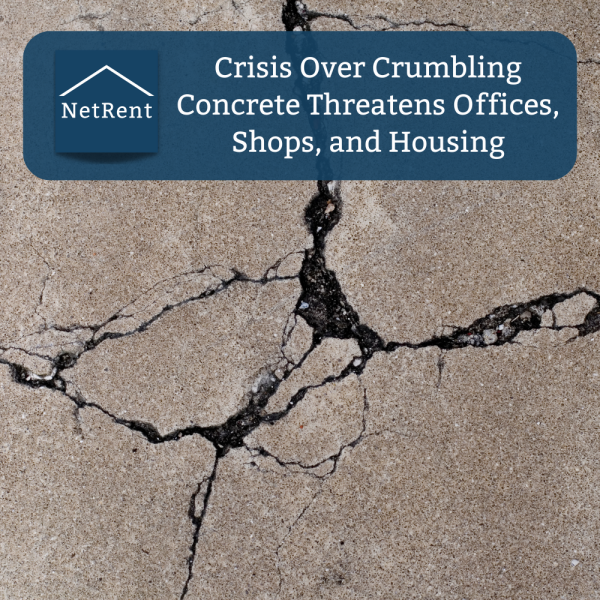
The crisis sparked by the discovery of crumbling concrete in schools has sent shockwaves across Britain, raising fears that this structural issue could extend beyond educational institutions to offices, shops, and housing. Landsec, one of the nation’s largest landlords, has taken a proactive step by announcing a comprehensive review of its post-war buildings to identify any potential presence of the reinforced autoclaved aerated concrete (RAAC).
This move comes in the wake of calls to action for councils and housing associations to scrutinize their building stocks for this concerning material, likened to an “Aero bar.” The Regulator of Social Housing (RSH) has acknowledged that RAAC may not be widespread in post-war tower blocks but has nonetheless urged all social housing providers to assess their structures for its presence. Experts have even suggested that RAAC could be lurking in some high-rise roofs, intensifying the urgency of these reviews.
The nation’s largest housing association, Clarion Housing Group, has already commenced its examination of buildings potentially affected by RAAC. Furthermore, a prominent property consultancy revealed that it had been approached by another housing association to evaluate eight of its older buildings for RAAC-related concerns.
The National Housing Federation (NHF), representing social housing associations across England, is currently in discussions with its members to determine the most effective approach to identify RAAC issues within their housing stock. An NHF spokesperson emphasized their commitment to providing updated guidance and support to their members and the government regarding this matter.
The Local Government Association (LGA) has issued directives to councils, instructing them to investigate the presence of RAAC in their buildings, including those in the social housing sector. According to Steve McSorley, director of the structural engineering consultancy Perega, RAAC is less likely to be prevalent in 1960s tower blocks, but it might be discovered in certain roofs. He highlighted that the private sector, comprising offices, factories, department stores, and shops, could be facing a more significant challenge since there is no government oversight for these assessments.
Mark Allan, CEO of Landsec, affirmed the company’s commitment to survey for RAAC, with a particular focus on a limited number of post-war buildings. He emphasized that responsible property ownership necessitates understanding potential RAAC exposure, stating, “It is incumbent on any responsible property owner to do some work to understand where we might have exposure.”
The Institution of Structural Engineers has urged commercial property owners to conduct surveys aimed at identifying or eliminating the possibility of RAAC in their buildings. Mark Reynolds, head of the Construction Leadership Council, mentioned that no commercial buildings at risk of RAAC-related problems had been identified thus far. However, he cautioned that this assessment could change as more companies and individuals investigate or become aware of the risks.
Legal experts from Winckworth Sherwood, specializing in social housing, emphasized that councils and housing associations have a legal obligation to manage their buildings, meet repair and maintenance obligations, and that inaction is not an option.
Campaigners have raised concerns that leaseholders on housing estates, who have already faced substantial bills for cladding work following the Grenfell tragedy, may now be liable for the costs associated with surveying buildings for RAAC. Liam Spender, a cladding campaigner, compared the potential snowball effect to the post-Grenfell inspections, noting, “After Grenfell, everybody and his dog started inspecting their buildings, and it may be the same with this.”
Experts have cautioned that some schools in England found to have crumbling concrete may have no choice but to undergo demolition if repair costs become prohibitively expensive. According to Mr. McSorley, the expenses associated with RAAC removal can vary widely, ranging from tens of thousands of pounds to multimillions, depending on the scale. His own firm is currently engaged in a £10 million project to address a RAAC roof issue.
As concerns escalate, the nation watches closely as property owners, councils, and housing associations embark on a nationwide quest to identify and address the potential threat posed by RAAC in the country’s buildings.