

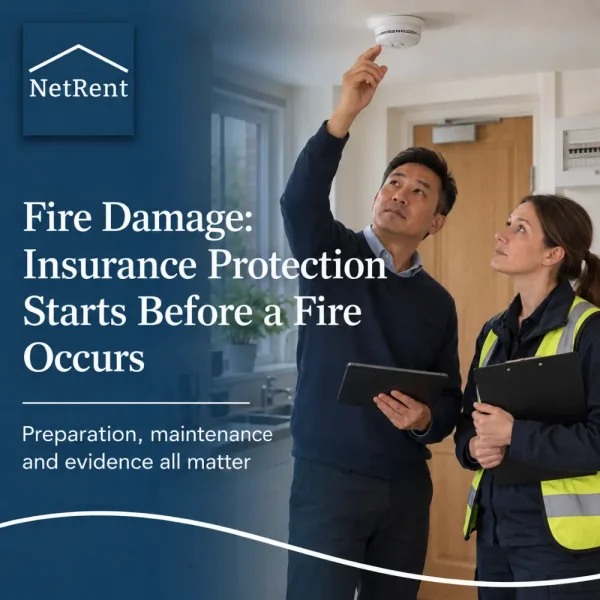
A serious fire can make a rental property uninhabitable within minutes. The damage may extend far beyond the area touched by flames: smoke, soot, heat, water used by the fire service and emergency access can affect the entire building.
Landlord insurance may provide vital financial protection, but insurance should never be treated as the first line of defence. Effective protection begins much earlier—with suitable cover, correct property information, regular maintenance, appropriate fire precautions and clear records.
What might landlord insurance cover?
Fire is commonly included as an insured event under landlord buildings insurance. Depending on the individual policy, cover may extend to:
- Repairing or rebuilding the insured structure
- Replacing damaged landlord-owned fixtures and fittings
- Removing debris and making the site safe
- Professional fees associated with reinstatement
- Damage caused by smoke and firefighting water
- Landlord contents, where this cover has been selected
- Loss of rent following insured damage
- Alternative accommodation costs in qualifying circumstances
- Property owners’ liability
The precise cover, limits, excesses and exclusions vary. A policy does not necessarily insure every cost arising from a fire, and a valid claim will depend on the cause, circumstances and policy terms.
The landlord should check that the property’s occupation, construction, use and rebuilding cost have been described accurately. A policy arranged for a conventional family let should not be assumed to cover an HMO, holiday let, supported accommodation or property undergoing major renovation.
Insurance and fire-safety duties are separate
Having buildings insurance does not demonstrate that a landlord has complied with fire-safety law. Equally, meeting the relevant legal minimum does not guarantee that every fire loss will be covered.
Insurance protects against specified financial losses. Fire-safety law and housing standards are intended to reduce danger to occupants and other people. Both require attention.
The necessary precautions depend on factors including:
- Which UK nation the property is in
- Whether it is a house, flat or HMO
- The number and needs of the occupants
- The building’s height, layout and construction
- Whether there are shared or communal areas
- The type of tenancy or occupation
- Licensing conditions
- Advice from the local authority or fire and rescue service
- Requirements imposed by the insurer
Landlords should therefore obtain property-specific guidance rather than relying on a generic checklist.
The rules differ across the UK
Fire-safety and alarm requirements are not identical in England, Wales, Scotland and Northern Ireland.
In England, relevant landlords must generally provide at least one smoke alarm on each storey containing living accommodation. Carbon monoxide alarms are required in rooms used as living accommodation containing fixed combustion appliances, excluding gas cookers. Prescribed alarms must be checked on the day a new tenancy begins, and landlords must repair or replace faulty alarms once informed and the fault is established.
In Wales, the fitness requirements applying to rented homes include more specific alarm standards. As a minimum, working smoke alarms are required on every storey and must be mains powered and interlinked. Carbon monoxide alarms are required in rooms containing specified gas, oil-fired or solid-fuel appliances. More complex properties and HMOs may require additional measures.
In Scotland, every home must have interlinked fire alarms. The national standard includes smoke alarms in the principal living room and hallways or landings, together with a heat alarm in the kitchen. Carbon monoxide protection is also required where relevant carbon-fuelled appliances are present. Private rented properties remain subject to the wider repairing and safety standards applying to landlords.
Northern Ireland has its own alarm requirements for private tenancies and separate fire-safety duties for licensed HMOs. Landlords should follow current Department for Communities guidance and any requirements imposed by the relevant council.
These are broad summaries, not a complete statement of the law. A landlord with properties in more than one nation should not apply the rules from one jurisdiction to the entire portfolio.
HMOs and blocks need particular attention
Shared and multi-occupied properties can require more extensive precautions because occupants may not form one household and escape routes may be used by several people.
Requirements can involve:
- A suitable fire-detection and alarm system
- Protected escape routes
- Fire-resistant doors and self-closing devices
- Emergency lighting
- Fire blankets or extinguishing equipment
- Fire-resistant furniture and furnishings
- Clear management of communal areas
- Regular testing, servicing and recording
- A current fire-risk assessment where required
The exact standard depends on the property, licence and national or local regime.
Landlords of flats must also distinguish between their responsibilities inside the dwelling and those applying to communal parts. The freeholder, residents’ management company, right-to-manage company or appointed managing agent may arrange block insurance and manage common-area fire precautions.
That division should be confirmed rather than assumed. A defective flat entrance door, obstructed corridor or problem with a communal alarm system may involve more than one responsible party.
Maintenance can prevent a fire—and support a claim
Many serious incidents begin with an everyday defect: an overloaded electrical circuit, damaged appliance, poorly maintained boiler, unsafe heater or compromised fire door.
A sensible maintenance programme should include:
- Required electrical inspection and testing
- Gas-safety checks where gas is supplied
- Servicing of heating and combustion appliances
- Inspection of landlord-provided electrical appliances
- Testing and maintenance of alarms and emergency lighting
- Prompt repair of damaged fire doors and self-closing devices
- Keeping escape routes clear
- Removing accumulations of waste or combustible material
- Investigating reports of burning smells, overheating or repeated electrical tripping
- Checking work completed by competent contractors
Insurance is generally not designed to pay for wear and tear, gradual deterioration or the routine replacement of a defective component. It may cover resulting fire damage where the policy responds, but the component that failed may remain the landlord’s responsibility.
Known defects should never be left because a policy is in place. Failure to maintain the property or comply with a relevant policy condition could affect the insurer’s assessment of a claim.
Keep evidence before anything goes wrong
After a major fire, the original condition of the property may be difficult to establish. Good records can help the landlord demonstrate how the building was maintained and what was present before the loss.
Keep:
- The current policy schedule and wording
- An up-to-date rebuilding cost assessment
- Inventories and dated photographs
- Alarm installation, testing and service records
- Electrical and gas-safety documentation
- Appliance service and purchase records
- Fire-door and emergency-lighting records
- Inspection reports
- HMO licences and associated conditions
- Fire-risk assessments where applicable
- Invoices for repairs and improvement work
- Written reports from tenants about faults and the landlord’s response
- Evidence of access attempts where a tenant has not allowed essential work
Records should be stored somewhere that remains accessible if the property, office or landlord’s computer is damaged.
Evidence does not guarantee that a claim will be paid, but it can make the circumstances much easier to investigate.
Give tenants clear information
Tenants also influence everyday fire safety. At the start of the tenancy, explain how alarms should be tested, how faults should be reported and which escape routes must remain clear.
Tenants should know:
- How to raise an urgent safety concern
- Where keys for exit doors are kept
- That fire doors must not be wedged open
- That smoke or heat alarms must not be removed, covered or disabled
- That communal corridors and stairs must remain unobstructed
- Who to contact following an incident
Landlords should respond promptly when a tenant reports a faulty alarm, damaged electrical fitting or other fire risk. Keep the report, response and repair evidence together.
Where occupants have hearing, sight, mobility or other needs, specialist alarms or an adapted evacuation approach may be necessary. Seek appropriate advice for the particular property and occupants.
Tell the insurer when the risk changes
The insurer or broker should be contacted if circumstances change materially during the policy year.
Examples include:
- Converting the property into an HMO
- Increasing the number of occupants or bedrooms
- Undertaking structural work or substantial renovation
- Leaving the building unoccupied
- Changing the type of tenant or tenancy
- Installing a wood-burning stove or other new heating system
- Changing the commercial use of part of the building
- Discovering combustible construction materials or another significant risk
- Receiving fire-safety enforcement action or new licence conditions
The insurer may ask questions, impose conditions or recommend a different form of cover. Obtain confirmation in writing.
Check the rebuilding cost and loss-of-rent cover
A major fire claim can expose underinsurance that remained unnoticed for years.
The rebuilding cost is not the property’s market value. It may need to include demolition, debris removal, professional fees, site access and reconstruction in accordance with current standards. Listed buildings, unusual construction and properties with extensive alterations may require a professional assessment.
Loss-of-rent protection also needs careful attention. Check:
- The maximum amount payable
- How the insured rent is calculated
- The maximum payment period
- Whether the limit reflects the property’s current rent
- Which events activate the cover
- How alternative accommodation is treated
Reinstatement after a serious fire can be lengthy. Investigations, planning, drying, approvals, specialist materials and contractor availability can all extend the interruption.
What should happen after a fire?
People’s safety comes first. Follow the instructions of the emergency services and do not enter the property until it is safe.
As soon as reasonably possible:
- Contact the insurer or the claims number shown in the policy documents.
- Notify the broker so the available claims support can begin.
- Take reasonable steps to prevent further damage, subject to emergency-service and insurer instructions.
- Photograph the damage when it is safe to do so.
- Retain damaged items unless they create a safety hazard or the insurer authorises disposal.
- Keep receipts for emergency measures and temporary costs.
- Avoid admitting liability or agreeing settlements with third parties.
- Record all conversations, decisions and requested documents.
Do not begin substantial clearance or permanent repair work without consulting the insurer, unless immediate action is necessary to protect people or prevent further loss.
The insurer may appoint a loss adjuster, surveyor, investigator, restoration company or specialist contractor. Notification does not itself confirm that the claim has been accepted; the insurer must establish the cause and whether the policy responds.
Review protection before a fire occurs
Landlords should ask:
- Is the property and its occupancy accurately described?
- Are the buildings and landlord contents sums adequate?
- Is loss-of-rent cover sufficient in amount and duration?
- Are fire, malicious damage and alternative accommodation provisions understood?
- Have all alarm, electrical, heating and fire-safety duties been checked for the correct UK nation?
- Are HMO, block or licensing responsibilities clear?
- Are maintenance and inspection records complete?
- Have changes to the property been reported?
- Are tenants given clear reporting and fire-safety information?
NetRent works with Clear Insurance Management and its experienced property-insurance team to help landlords review these matters properly.
If your landlord insurance is approaching renewal, send us your existing documents so we can examine the property information, cover, conditions and premium.
Telephone: 01352 721300
Email: insurance@netrent.co.uk
Insurance becomes essential after a fire, but meaningful protection begins long before the first sign of smoke.
NetRent does not provide legal advice. This article represents our general understanding of the landlord insurance and rental property market and is provided for information only.