

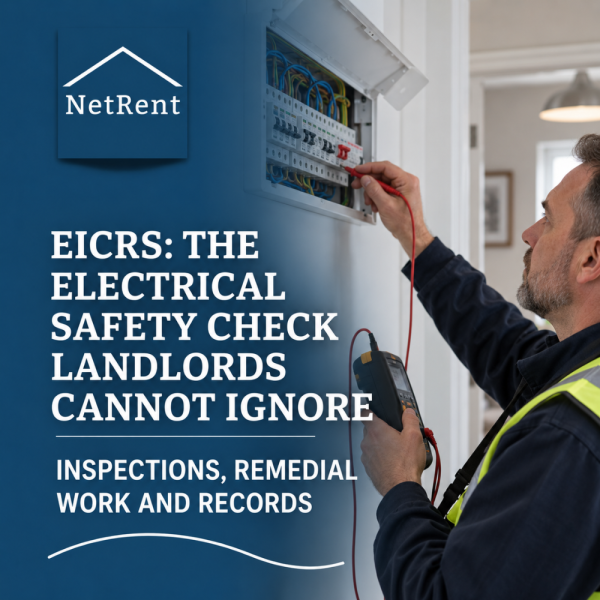
Electrical safety is one of the core responsibilities of a residential landlord, and the Electrical Installation Condition Report — usually shortened to EICR — is central to demonstrating compliance.
For most private rented properties in England, the electrical installation must be inspected and tested by a suitably qualified person at least every five years, or sooner if the previous report requires it.
The important point for landlords is that obtaining the report is only the beginning. An unsatisfactory EICR can require further investigation or remedial work, and there are deadlines for supplying documents to tenants.
What does an EICR cover?
An EICR examines the fixed electrical installation within the property.
That normally includes items such as:
- wiring;
- sockets;
- light fittings;
- switches;
- consumer units; and
- other fixed electrical components.
The inspection is designed to identify deterioration, defects and electrical hazards that could make the installation unsafe.
The person carrying out the inspection should be qualified and competent to undertake this type of work.
How often is an inspection required?
The electrical installation must generally be inspected and tested at intervals of no more than five years.
However, landlords should check the actual EICR because the inspector can specify an earlier date for the next inspection.
Do not simply enter “five years from today” into a diary without checking what the report says.
Understanding the EICR codes
An EICR may contain classification codes describing defects or recommendations.
The important ones include:
C1 — Danger present
This indicates an immediate risk of injury and requires urgent attention.
C2 — Potentially dangerous
Remedial work is required.
FI — Further Investigation
Further investigation is required without delay.
C3 — Improvement recommended
This does not normally make the report unsatisfactory by itself. It is a recommendation rather than mandatory remedial work under the electrical-safety regulations.
Landlords should not simply file away an EICR marked “unsatisfactory”. They need to understand what work follows from it.
How quickly must remedial work be completed?
Where the report identifies required remedial or further investigative work, landlords generally need to ensure it is completed within 28 days, or sooner where the report specifies a shorter period.
Once the work has been completed, obtain written confirmation from the electrician.
Keep that confirmation with the original EICR so there is a clear record showing:
- what defect was found;
- what work was required;
- when the work was completed; and
- who completed it.
Give the tenant a copy
Existing tenants should generally receive a copy of the EICR within 28 days of the inspection.
A new tenant should receive a copy before occupying the property.
A prospective tenant who asks for the report should generally receive it within 28 days of their request.
Landlords should retain evidence showing when the report was supplied.
Email can make this relatively straightforward because the sent message provides a useful record.
What if the council asks for it?
A local authority can request a copy of the report.
Landlords should therefore keep EICRs somewhere they can be found quickly rather than relying entirely on an electrician or managing agent to retain them.
Local authorities also have enforcement powers where landlords fail to comply with electrical-safety requirements.
What if the tenant refuses access?
Electrical inspections can become difficult where a tenant repeatedly refuses access.
A landlord should not simply force entry.
Instead, keep a written record of reasonable attempts to arrange the inspection, including:
- emails;
- text messages;
- letters;
- proposed appointment dates;
- contractor communications; and
- records of missed appointments.
Continue trying to arrange access and consider obtaining specialist advice if the inspection cannot be completed.
The objective is to demonstrate a genuine and continuing effort to comply.
Using a letting agent?
If an agent manages the property, establish exactly who is responsible for monitoring the EICR.
Ask:
- When does the current report expire?
- Who books the inspection?
- Who sends the report to the tenant?
- Who monitors remedial work?
- Where are the certificates stored?
Landlords should keep their own copy even where the agent handles the process.
What about portable appliances?
An EICR principally concerns the fixed electrical installation.
Landlords should not confuse this with checking portable electrical appliances they provide, such as kettles, fridges or washing machines.
Those appliances still need to be safe, but that is a separate issue from the fixed-installation inspection.
How does the position differ elsewhere in the UK?
The requirements discussed above apply to England.
Wales, Scotland and Northern Ireland have their own rental frameworks and electrical-safety requirements. Landlords with properties in more than one jurisdiction should therefore check the rules applying to each property rather than relying on a single UK-wide procedure.
Make the EICR part of your compliance calendar
For every relevant property, landlords should know:
- the date of the current EICR;
- when the next inspection is due;
- whether the report was satisfactory;
- whether remedial work was required;
- whether that work was completed; and
- whether the tenant received the required documentation.
An EICR should not be something landlords think about once every five years. It should form part of an organised property compliance file.
NetRent’s Landlord Legal Updates will continue to explain important requirements affecting landlords, letting agents and tenants across the UK.
NetRent also supports landlords with landlord insurance, mortgages and property sales.
Telephone: 01352 721300
Email: support@netrent.co.uk
Important information
NetRent does not provide legal advice. The articles represent our understanding of rental property law and are for general information only.