

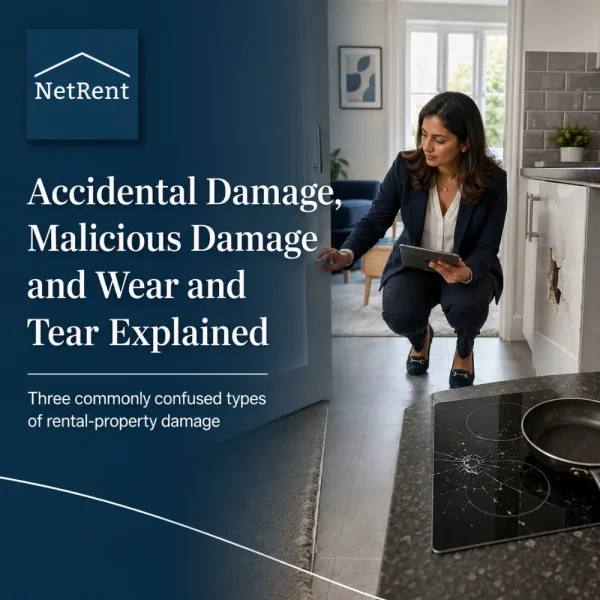
A cracked ceramic hob, a damaged internal door and a worn carpet may all require money to put right—but they do not necessarily fall into the same insurance category.
For landlords and letting agents, the cause of the damage matters. An insurer may treat a sudden accident very differently from a deliberate act or deterioration caused by ordinary use over time. The tenancy deposit may also be relevant, but it is not a substitute for suitable insurance.
Understanding the difference can help landlords arrange appropriate cover, record incidents properly and avoid unrealistic expectations when a claim is made.
What is accidental damage?
Accidental damage is generally damage caused by an unforeseen and unintentional event. The exact definition in the policy is important, and some policies require the incident to be sudden as well as unexpected.
Possible rental-property examples include:
- A tenant drops a heavy pan and cracks a ceramic hob
- A washbasin is broken when an object falls onto it
- Paint is accidentally spilled over a landlord-owned carpet
- A piece of furniture is knocked over and damages a wall
- A tenant accidentally puts a nail through a concealed pipe
- A window or glazed door is broken during an everyday household accident
These examples are not guarantees of cover. The insurer will consider what happened, whether the damaged item is insured, which section of the policy applies, and whether an exclusion or excess affects the claim.
Buildings insurance and landlord contents insurance may also treat the same incident differently. A fitted kitchen worktop is normally part of the building, while a freestanding table is more likely to be treated as contents. Landlords should therefore check that both the property and the items they provide are insured appropriately.
Accidental damage may not be included automatically
Some landlord policies include a level of accidental-damage protection as standard. Others offer it as an optional extension or restrict it to specified items, such as sanitary fittings, fixed glass or underground pipes.
A landlord should not assume that a policy covers every accident simply because it insures the building.
At renewal, check:
- Whether accidental damage is included for buildings
- Whether it is included for landlord-owned contents
- Which limits and excesses apply
- Whether damage caused by tenants is covered
- Whether particular occupants, properties or tenancy arrangements are excluded
- Whether damage during building work or unoccupancy is restricted
The schedule and full policy wording should be read together.
What is malicious damage?
Malicious damage generally involves a deliberate act intended to cause damage. This is different from an accident, carelessness or gradual neglect.
Possible examples include:
- A door being deliberately kicked in
- Kitchen units being intentionally smashed
- Walls being purposefully damaged
- Landlord-owned furniture being deliberately destroyed
- Windows being broken as an act of vandalism
The insurer will need evidence about the circumstances. Damage may be obvious, but intention is not always easy to establish. A broken door could have resulted from a deliberate act, an attempt to gain emergency access or a genuine accident. The description given to the insurer should therefore be factual rather than based on assumptions.
Malicious-damage cover varies considerably. A policy may distinguish between damage caused by a tenant, a guest, an intruder or another third party. It may set a separate limit or excess, require particular tenant checks, or exclude certain circumstances altogether.
Landlords should check the wording before assuming that deliberate damage by a tenant is insured.
When should the police be contacted?
If the circumstances suggest criminal damage, burglary or vandalism, the landlord or agent should consider contacting the police promptly. The policy may require a crime reference number or evidence that the incident was reported within a specified period.
Safety comes first. Nobody should confront an occupant or enter a property in circumstances that could place them at risk. The insurer should also be contacted promptly and its reporting instructions followed.
What is wear and tear?
Wear and tear is the gradual deterioration that occurs through normal use, age and exposure. Insurance is not generally designed to pay for routine maintenance or the ordinary replacement of items that have reached the end of their useful life.
Examples may include:
- Carpet becoming worn along a busy walkway
- Paintwork becoming marked or faded over time
- Furniture showing ordinary signs of use
- Sealant and grout deteriorating with age
- Appliances wearing out through normal operation
- Roof coverings gradually deteriorating
- Hinges, handles and fittings loosening through repeated use
Wear and tear is not the same as damage caused by one identifiable incident. A carpet that has gradually flattened and faded is different from a carpet seriously stained by a single accidental spillage.
The difference may affect both an insurance claim and any proposed tenancy-deposit deduction.
Fair wear and tear and the tenancy deposit
A landlord should not expect a tenant to return every item in brand-new condition. Reasonable use during the tenancy must be taken into account.
When assessing damage at check-out, relevant factors can include:
- The item’s age and quality at the start of the tenancy
- Its original condition
- The length of the tenancy
- The number and type of occupants
- The item’s normal expected lifespan
- The extent of deterioration beyond ordinary use
If a five-year-old carpet is damaged, the landlord should not normally expect the tenant to fund a completely new replacement without allowance for its age and prior use. This is sometimes described as avoiding betterment.
A deposit is not insurance, and the same financial loss should not be recovered twice. Deposit rules and dispute procedures differ across England, Wales, Scotland and Northern Ireland, so landlords and agents must follow the arrangements that apply where the property is located.
The difficult cases sit between the categories
Not every incident fits neatly into one label.
Poor housekeeping may cause damage gradually. A small maintenance issue may become worse because it was not reported. A pet may scratch a door over several months. A bathroom floor may deteriorate because water repeatedly escaped from a shower. An appliance may fail because of age rather than a sudden event.
In these cases, the insurer may consider:
- Whether there was a single identifiable incident
- Whether the damage was unforeseen and unintentional
- How quickly the damage developed
- Whether maintenance was required
- Whether reasonable steps were taken to prevent further damage
- Whether defective workmanship or gradual deterioration contributed
- What the policy specifically excludes
Landlords and agents should record what is known and avoid forcing the facts into whichever category appears most favourable. The insurer decides whether the circumstances fall within the policy.
Evidence can determine how the incident is understood
Clear records help distinguish new damage from an existing defect or ordinary deterioration.
Useful evidence can include:
- A detailed check-in inventory
- Dated photographs from the beginning and end of the tenancy
- Routine inspection records
- The tenant’s account of what happened
- Photographs and video taken immediately after discovery
- Repair reports and estimates
- Evidence of the damaged item’s age, ownership and original cost
- Maintenance and servicing records
- Police or crime-reference details where relevant
Photographs should show both the wider area and close views of the damage. Unless removal is necessary for safety or to prevent further loss, damaged items should be retained until the insurer confirms that they are no longer needed for inspection.
Report the facts promptly
When damage is discovered, landlords and agents should:
- Make the property safe and take reasonable steps to prevent further damage.
- Photograph the damage before permanent repairs begin.
- Record when it was discovered and what each person says happened.
- Check the policy’s claims procedure and notification deadline.
- Contact the insurer or broker before authorising substantial non-emergency work.
- Retain invoices, estimates, damaged items and correspondence.
Emergency work may be necessary, but insurers should normally be given the opportunity to assess substantial repairs. Reporting an incident does not mean that the claim has been accepted.
Letting agents should not promise a landlord or tenant that insurance will pay. Their role is to preserve accurate information, notify the appropriate parties and follow the agreed reporting process.
Review the distinctions at renewal
Before renewing landlord insurance, ask:
- Does the policy include accidental damage to the building?
- Are landlord-owned contents also protected?
- Is malicious damage by tenants included or available as an extension?
- Are there separate limits or excesses?
- Do exclusions apply to particular tenant groups or property types?
- What evidence and reporting timescales are required?
- Are unoccupied periods or renovation work treated differently?
NetRent works with Clear Insurance Management and its experienced property-insurance team to help landlords review these details properly.
If your landlord insurance is approaching renewal, send us your existing documents so we can examine the cover, conditions, excesses and premium. We can also discuss accidental-damage and malicious-damage protection in the context of the property’s actual use and occupancy.
Telephone: 01352 721300
Email: insurance@netrent.co.uk
Accidental damage, malicious damage and wear and tear can sometimes look similar at first. Establishing what happened—and having the right evidence and policy wording—can make all the difference.
NetRent does not provide legal advice. This article represents our general understanding of the landlord insurance and rental property market and is provided for information only.