

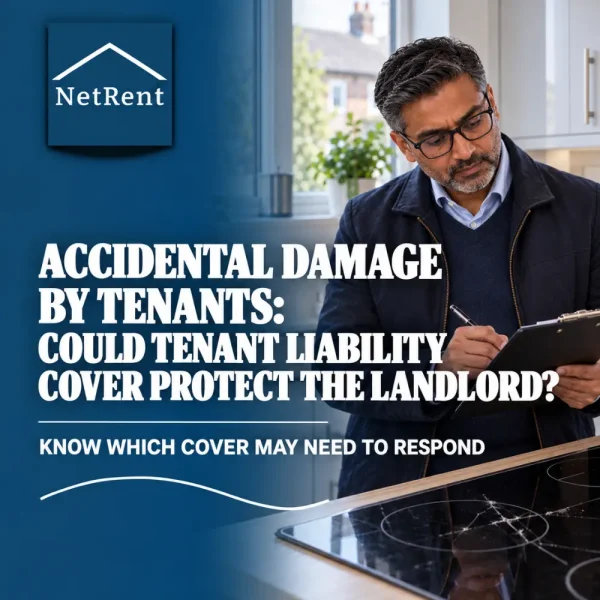
A tenant cracks a ceramic hob, spills wine across the landlord’s carpet or allows a bath to overflow and damage the ceiling below.
These incidents may be described as accidental damage, but that does not establish which insurance, if any, should respond. The answer might involve the landlord’s buildings or contents policy, a tenant liability product, the deposit or direct recovery from the tenant.
Understanding those different routes can help landlords avoid assumptions before a tenancy begins or a claim occurs.
What is tenant liability cover?
Tenant liability cover addresses certain accidental damage for which a tenant is legally responsible to the landlord. It may relate to fixtures, fittings, furniture or other landlord-owned property, but limits, excesses, exclusions and claim procedures vary.
The potential benefit is an insured route when a tenant accidentally damages landlord-owned property and is responsible. It may also reduce pressure on the deposit, which might be needed for other legitimate deductions.
It is not, however, a universal guarantee. The damaged item, cause, circumstances and person responsible must fall within the policy terms. The insurer will decide whether a claim is covered.
How could it work in practice?
If a tenant drops an object onto the landlord’s glass dining table, suitable liability cover may consider the tenant’s responsibility, subject to its terms.
If a tenant damages a fitted worktop, it may form part of the building rather than contents. Tenant liability cover might be relevant, but the buildings insurer may also require notification. The correct route depends on the policies and facts.
Ordinary wear is not the same as a sudden accident. A worn carpet, failing old appliance or gradual deterioration does not become accidental damage merely because it happened during a tenancy.
These examples show why the label “tenant damage” is too broad. The cause and responsibility matter more than the label.
Is tenant liability cover the same as landlord accidental-damage cover?
No. Landlord accidental-damage cover, where included, extended or purchased, forms part of the landlord’s own insurance arrangements. It may protect insured buildings or landlord-owned contents against specified accidental damage, subject to the policy.
Tenant liability cover is based on the tenant’s potential legal responsibility. The protections approach an incident differently and may not cover identical property or events.
Check whether accidental damage is automatic, optional or excluded for particular occupants, properties or causes. Also check the excess and possible effect on claims history. One form of cover does not prove the other is unnecessary.
What is unlikely to be treated as accidental damage?
Each policy supplies its own definition of accidental damage. Areas that may fall outside cover include:
- Fair wear and tear or gradual deterioration
- Poor maintenance, defective workmanship or inherent defects
- Deliberate or malicious acts
- Damage known about before cover began
- Damage to property not included within the relevant definition
- Losses below the excess or above the policy limit
- Incidents not reported within the required process
Malicious damage is different from an accident and may require specific landlord cover. Do not assume tenant liability protection responds simply because the tenant caused the damage.
Does the tenancy deposit still matter?
Yes. A protected deposit remains security against relevant tenant obligations, subject to the agreement, deposit rules and evidence. It is not insurance, and the full replacement cost cannot automatically be deducted.
Fair wear and tear, age, starting condition and expected lifespan affect a reasonable deduction. A landlord should not receive betterment by replacing an older item with a new one entirely at the tenant’s expense.
A detailed inventory, signed check-in, dated photographs, invoices and check-out evidence are essential. Without the starting condition, proving when damage occurred and calculating a fair loss can be difficult.
Deposit legislation and processes differ across England, Wales, Scotland and Northern Ireland. Landlords should follow the rules applying where the property is located and should not use an insurance discussion as a substitute for complying with deposit requirements.
What should happen when accidental damage is reported?
Establish what happened, when, what was damaged and whether urgent action is needed. Obtain photographs and a written account. Do not discard damaged items or authorise permanent repairs before consulting relevant claims contacts unless safety or damage limitation requires action.
Check whether the landlord’s policy requires notification even if the tenant has liability cover. The tenant should follow their product’s reporting requirements. Prompt communication is safer than assuming the cost can be taken from the deposit later.
Why the right conversation matters
Tenant-caused damage shows why landlord insurance should not be reduced to a quick premium comparison. NetRent has worked with landlords for more than 23 years. We speak with every client to understand the property, tenancy and existing arrangements before introducing them to Clear Insurance Management. This can reveal overlooked questions about accidental damage, malicious damage, contents, excesses and tenant types.
NetRent is the insurance introducer; Clear provides regulated insurance broking services and considers the available options. NetRent remains available to assist throughout because we seek long-term working relationships with landlords. Through the scale of the landlord business we introduce and our relationship with Clear, we aim to help landlords obtain appropriate, cost-effective insurance rather than choose solely on headline price.
Before renewal, send NetRent your current schedule and documents. Call 01352 721300 or email insurance@netrent.co.uk. You can also explore NetRent’s Property Insurance Information Centre for further guidance.
NetRent does not provide legal advice. This article represents our general understanding of the landlord insurance and rental property market and is provided for information only.