

New research puts household relationships under scrutiny and raises questions about how shared homes are let and managed
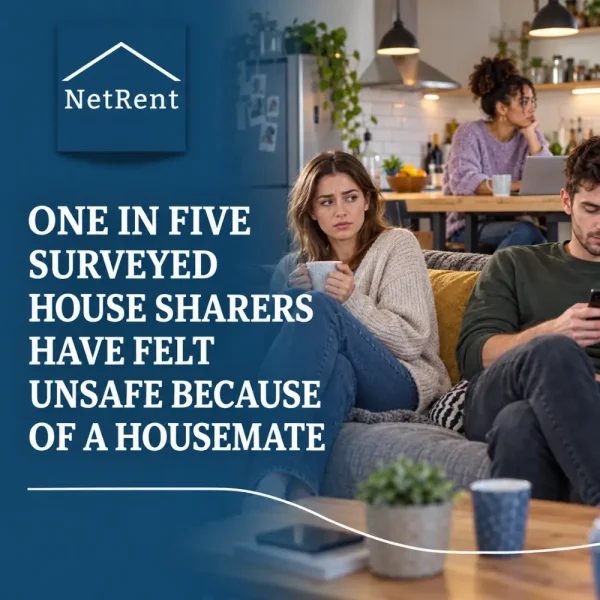
More than one in five current house sharers responding to a new UK survey say they have felt unsafe at some point because of another housemate. The finding highlights a part of the rental experience that property inspections and rent calculations cannot fully capture.
COHO’s State of Shared Living 2026 report, covered by the property press on 13 October, records that experience among 21.3 per cent of respondents. Yet 79.8 per cent say they feel safe in their shared house overall. These answers are not necessarily contradictory: someone can feel comfortable now while having experienced an unsettling incident previously.
Moving in without knowing the household
The survey included 5,145 people currently living in shared houses. Some 42.3 per cent said they had no information about who they would live with before moving in, while 52.5 per cent wanted a say in who joined the household.
For a landlord letting individual rooms, that presents a different question from whether an applicant can afford the rent. Each new letting also changes the home of the people already there. A room can be suitable in size, condition and price while the household proves difficult to live in.
Information about everyday arrangements could help applicants judge that fit. Working hours, expectations about noise and how communal spaces are used may matter more to daily life than an attractive room photograph. This does not mean everyone in a house must have the same interests or background, or that existing tenants should control access to housing.
Why the findings matter to landlords
The commercial implication is straightforward, although the survey cannot quantify it. If an uncomfortable household prompts a tenant to leave, a landlord may face another void, further advertising and additional time arranging viewings. A fully occupied house is not necessarily a settled one.
The findings therefore invite attention to what happens between individual lettings. A tenant’s complaint about another occupier can affect the viability of the whole household, rather than just the relationship between landlord and complainant. Understanding whether the issue concerns ordinary friction, repeated disruption or a serious safety concern matters to how it is handled.
However, the report does not establish that a matching service prevents harm or guarantees longer tenancies. Nor does a stated preference for compatible housemates demonstrate what applicants would actually pay. Claims about financial benefits need evidence beyond this survey.
A tenant concern with important limits
For tenants, choosing a room also means choosing an environment in which they will sleep, cook and spend time away from work. Limited information can make that decision harder, particularly where affordability restricts the available alternatives.
Greater transparency has limits too. Existing occupiers have privacy interests, and compatibility must not become a convenient label for excluding people unfairly. The survey is evidence of preferences and experiences, not permission to disclose personal details or bypass legal protections.
The research was conducted online between 7 May and 31 July 2026 and promoted through COHO’s channels and other networks. It was not a random national sample. Percentages use the respondents answering each question, so the headline findings should not be treated as estimates for every UK shared home.
COHO supplies property-management software and has a commercial interest in shared living. That does not invalidate the responses, but it is relevant context when assessing the company’s interpretation.
What has changed and what has not
The development is fresh evidence about the experience inside shared homes, rather than a new rule for landlords. No new statutory duty arises from the publication of this report, and the findings do not establish that every house in multiple occupation is unsafe.
They do expose a gap between letting a room successfully and maintaining a household in which people feel comfortable. For landlords, tenant retention and the handling of concerns deserve attention alongside occupancy. For tenants, an affordable room has greater value when the shared home around it also works.
NetRent does not provide legal advice. This article represents our understanding of rental property law and is provided for general information only. Landlords should obtain independent legal or professional advice where appropriate.
Telephone: 01352 721300
Email: support@netrent.co.uk