

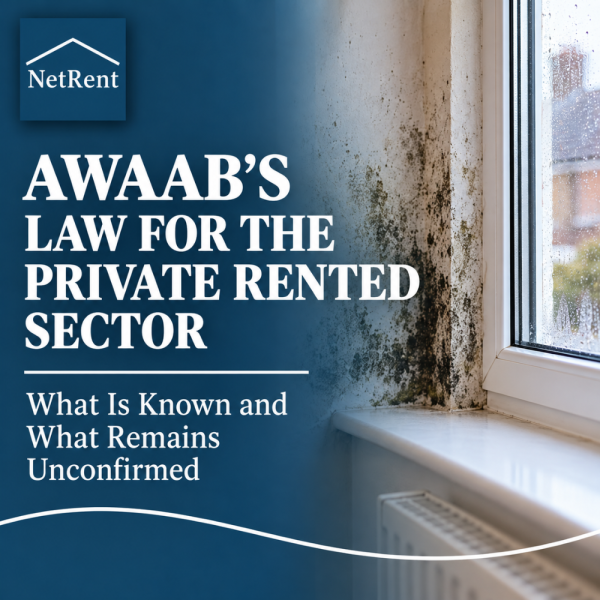
Awaab’s Law has become one of the most important housing standards reforms in recent years because it introduces legally enforceable timescales for dealing with serious hazards such as damp and mould.
The first phase applies to social housing, but private landlords should not assume the issue stops there.
The Government has made clear that similar protections are intended for the private rented sector, although the detailed timetable and final operating rules for private landlords are still not fully confirmed.
That makes this an important moment for landlords to separate what is already known from what still needs legislation and guidance.
What is Awaab’s Law?
Awaab’s Law was introduced following the death of two-year-old Awaab Ishak, who lived in a social rented home affected by severe mould.
The law is intended to prevent landlords from allowing serious hazards to remain unresolved for long periods after being reported.
The central principle is simple:
Where a serious housing hazard is reported, the landlord must investigate and act within defined timescales.
For the social rented sector, the first phase of the law is already being implemented through statutory deadlines.
Does Awaab’s Law currently apply to private landlords?
Not yet in the same way.
The detailed statutory timetable currently applies to social landlords.
However, the Government has stated that Awaab’s Law-style protections will also be extended to the private rented sector as part of wider rental reform.
That means private landlords should expect tighter rules around:
- investigation;
- repair timescales;
- written communication;
- record keeping; and
- evidence of action taken.
The exact timetable and final requirements for private landlords still need to be confirmed.
Why private landlords should prepare now
Even before a private-sector version takes effect, landlords already have legal responsibilities relating to housing conditions.
Those include duties connected with:
- fitness for human habitation;
- repairing obligations;
- Housing Health and Safety Rating System hazards;
- damp and mould;
- electrical safety;
- gas safety;
- fire safety; and
- local authority enforcement.
Awaab’s Law will not replace those duties.
It is more likely to add a clearer timetable to the way serious hazards must be handled.
Landlords who already respond quickly and keep good records will therefore be in a much stronger position when the private-sector rules arrive.
Damp and mould will remain a major focus
Although Awaab’s Law is wider than damp and mould alone, those problems are likely to remain central.
Damp and mould cases can involve:
- leaking roofs;
- defective gutters;
- failed pointing;
- plumbing leaks;
- poor ventilation;
- inadequate heating;
- cold bridging;
- insulation defects; and
- persistent condensation.
The important point is that visible mould is often only the symptom.
A landlord who simply wipes down a wall or repaints over staining may not have dealt with the actual cause.
The first step is always proper investigation
One of the strongest themes running through modern housing regulation is that landlords must understand the underlying problem.
When a tenant reports damp, mould or another serious hazard, landlords should record:
- when the report was received;
- what the tenant described;
- photographs where available;
- whether the issue appears urgent;
- when an inspection was arranged;
- who carried it out; and
- what was found.
This creates a clear timeline from the first report.
That timeline may become particularly important once statutory deadlines apply.
Do not automatically blame lifestyle
Damp and mould disputes can quickly become arguments about condensation, heating and ventilation.
Tenant behaviour may sometimes contribute to moisture levels, but landlords should avoid making assumptions before the property has been properly inspected.
Statements such as:
“the tenant is not opening the windows”
or
“they are drying clothes indoors”
may be relevant, but they do not prove that the building itself has no defect.
A better approach is to investigate:
- ventilation;
- insulation;
- heating;
- leaks;
- structural defects; and
- occupancy patterns
before reaching a conclusion.
Written responses are likely to become more important
Awaab’s Law places strong emphasis on defined processes rather than informal handling.
Private landlords should therefore get used to confirming important issues in writing.
After an inspection, the tenant should ideally be told:
- what was found;
- what work is required;
- who will carry it out;
- when it is expected to begin; and
- what happens next.
Where no repair is considered necessary, the landlord should record the reasons.
That kind of written record can help resolve misunderstandings before they develop into formal disputes.
Access problems must be documented
We recently covered tenant access in this Landlord Legal Updates series.
That issue is directly relevant here.
A landlord cannot investigate or repair a problem if access is repeatedly refused.
But the landlord should be able to show that reasonable attempts were made.
Keep records of:
- access requests;
- dates offered;
- tenant responses;
- missed appointments;
- alternative dates; and
- contractor attendance.
If tighter statutory deadlines are introduced for private landlords, evidence of access attempts may become particularly important.
Contractors need to understand urgency
A landlord may react immediately to a serious hazard but still fail if the contractor treats the job as routine.
That means landlords should consider whether their repair arrangements are capable of responding quickly.
For portfolio landlords, it may be sensible to establish relationships with contractors who can deal with urgent:
- plumbing;
- heating;
- electrical;
- roofing;
- drainage; and
- damp-related problems.
Waiting until a serious complaint arrives before looking for someone to attend can create unnecessary delay.
Agents also need appropriate systems
Landlords using managing agents should ask how hazard reports are handled.
Important questions include:
- Who receives repair reports?
- How quickly are they reviewed?
- How are urgent cases identified?
- Who instructs contractors?
- How are landlords informed?
- How are access problems recorded?
- Where is the evidence stored?
An agent may handle day-to-day management, but landlords should still understand the process.
Serious hazards go beyond mould
Awaab’s Law is often discussed in the context of damp and mould, but serious housing risks can include much more.
Depending on the final private rented sector rules, issues could potentially include matters such as:
- dangerous electrical defects;
- significant heating failures;
- serious leaks;
- structural instability;
- fire hazards;
- carbon monoxide risk; and
- other conditions capable of causing serious harm.
Landlords should therefore think in terms of hazard management, not simply mould removal.
The Decent Homes Standard will add another layer
This article also connects directly with our recent update on the new Decent Homes Standard.
The direction of regulation is increasingly consistent.
Landlords are being expected to provide properties that are:
- safe;
- properly maintained;
- warm;
- free from serious hazards; and
- managed through clear documented processes.
Awaab’s Law and the Decent Homes Standard should therefore not be viewed as isolated reforms.
Together they point towards a much more structured approach to housing-condition enforcement.
Local authority enforcement already exists
Private landlords should not wait for Awaab’s Law to assume that serious housing hazards currently carry little risk.
Local authorities already have significant enforcement powers.
Where a property contains serious hazards, councils can investigate and may take formal action.
Depending on the circumstances, that can include:
- improvement notices;
- prohibition action;
- emergency measures;
- financial penalties; and
- prosecution.
A future private-sector Awaab’s Law is therefore likely to strengthen an existing enforcement framework rather than create one from nothing.
What remains unconfirmed?
At this stage, landlords should be cautious about treating proposed private-sector arrangements as final law.
Important details still requiring confirmation may include:
- the exact commencement date;
- which hazards are covered initially;
- investigation deadlines;
- repair commencement deadlines;
- completion requirements;
- rules for temporary accommodation;
- exceptions where access is impossible; and
- how enforcement will operate.
Until the final regulations are published, landlords should avoid relying on speculative deadlines.
What can landlords do now?
Even without the final private-sector timetable, landlords can prepare.
A sensible process would be to:
- record every serious repair or hazard report immediately;
- assess whether the problem may pose an urgent health or safety risk;
- arrange inspection quickly;
- document the findings;
- instruct appropriate contractors;
- keep the tenant informed in writing;
- record all access attempts;
- retain photographs and invoices;
- confirm when work is completed; and
- review whether the underlying cause has genuinely been resolved.
For portfolio landlords, this should become a standard property-management procedure.
The future direction is already clear
The precise private-sector version of Awaab’s Law is still developing.
But landlords do not need the final regulations to understand the direction.
The days when a serious complaint could sit unanswered in an inbox for weeks are disappearing.
The modern expectation is increasingly:
report, investigate, document, repair and follow up.
Landlords who build that process into their management systems now will be far better prepared when statutory timescales become mandatory.
NetRent’s Landlord Legal Updates are building a practical, searchable knowledge resource covering the legal and regulatory issues landlords face across the UK — connecting individual reforms so landlords can understand not only what is changing, but how the changes fit together.
NetRent also supports landlords with landlord insurance, mortgages and property sales.
Telephone: 01352 721300
Email: support@netrent.co.uk
Important information
NetRent does not provide legal advice. The articles represent our understanding of rental property law and are for general information only.